
From patient portals to B2B ecommerce platforms and corporate intranets, web portals vary greatly in terms of requirements, compliance, and core features. Businesses can find it hard to estimate web portal development costs, especially when they lack an understanding of project complexity, functional/non-functional requirements, risks and trade-offs.
Our experience shows that building a custom web portal with basic functionality and a few enhanced features may cost $30,000–$80,000 and more. The costs of web portal development have fallen in recent years due to the implementation of AI agents and tools in the software development lifecycle.
We’ll show you which features, factors, and extra costs can be hidden behind the figures.
Factors that influence web portal development cost
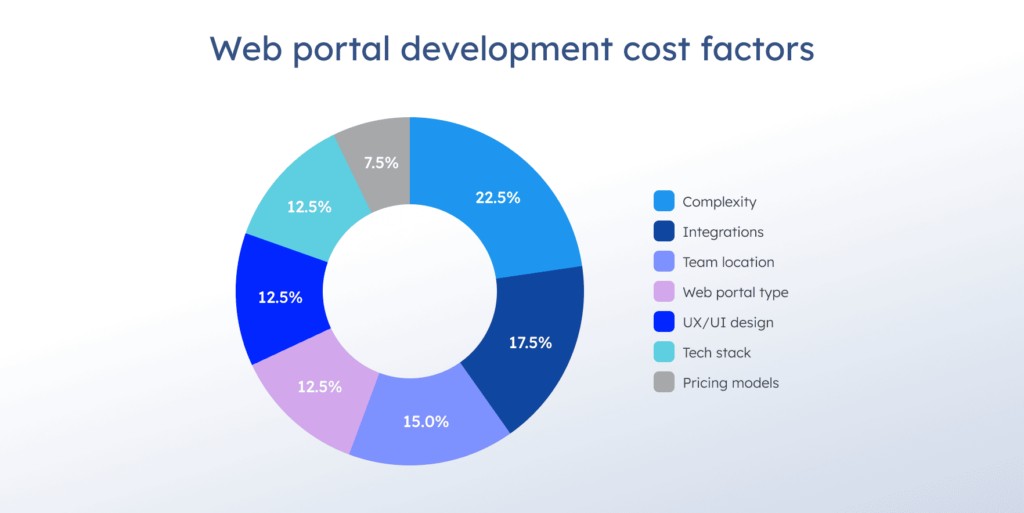
A web portal development budget encompasses many aspects. The wrong choices and inaccurate estimates here when put together, can increase the funding by 20–200%.
Project’s complexity
The development of a custom solution primarily depends on the web portal’s complexity, including the number of user roles, data management capabilities, and interface requirements. On average, it takes 100–300 hours to build a simple web portal, while advanced solutions might demand 1,500+ hours.
The project’s cost generally scales with the number of development hours. Nevertheless, advanced features such as data analytics and multi-step workflows often lead to sharper budget increases through expert work and thorough testing. Here’s an approximate cost breakdown.
| Portal complexity | Number of user roles | Team size | Project duration | Core features | Estimated cost |
|---|---|---|---|---|---|
| Simple | 1–2 | 3–4 | 2–3 months | User authentication, basic dashboard/content, admin panel | $15,000–$40,000 |
| Moderate | 3–5 | 5–7 | 4–6 months | Role-based access, workflow & document management, analytics dashboards | $50,000–$120,000 |
| Complex | 6+ | 8–12 | 7–18+ months | Advanced permissions, multi-tenant architecture, real-time data processing | $150,000–$250,000+ |
Integrations
Connecting your web portal to CRM, ERP, and BI tools, or adding multiple payment gateways, can drive project costs up, especially when you want to integrate with a legacy system that may not have proper APIs for a smooth linking. If ignored at the beginning, numerous and complex integrations can add 20–40% to your core development budget.
In integrations, the main cost drivers include developer effort to connect and test APIs, infrastructure expenses, maintenance, and updates when APIs change. For example, payment gateway integration with providers like Stripe and Adyen might cost $3,000–$8,000, while ERP system integration might cost $5,000–$50,000 to develop. Keep in mind the annual licensing or subscription fees, and expect them to take 5–20 % of your portal’s total operational budget.
Tech stack
There are several common tech stacks for web portal development: modern LAMP, MEAN, and MERN. Here are their core advantages and use cases.
LAMP
Includes Linux, Apache, MySQL, and PHP. It’s a stable and mature tech stack that ideally fits for building CMS-based portals and government/enterprise systems with structured data. The core benefits include a huge ecosystem, SEO opportunities, and affordable hosting everywhere.
Costs: is the cheapest upfront option, but the development takes time. MERN stack providers stable and predictable systems that are easier to maintain, yet might be harder to scale.
MEAN
The stack includes MongoDB, Express.js, Angular, and Node.js. MEAN stack suits for enterprise web portals, intricate dashboards, and complex admin panels. It tackles real-time capabilities and enables fast development. Web portals built on this stack efficiently handle multiple users simultaneously and are easy to deploy in the cloud due to their lightweight backend.
Costs: has moderate costs; Angular developers might have higher rates compared to LAMP. MEAN web portals are cheaper at scale and have a medium development speed.
MERN
Consists of MongoDB, Express.js, React, and Node.js. Replacing Angular with React offers maximum flexibility and faster UI development, making it a great choice for highly interactive portals with flexible data structures and real-time features. The examples of such web portals include multi-tenant systems, admin systems, and intranets.
Costs: moderate initial cost and lower change costs. MERN web portals are fast to build, easy to scale and maintain, and cheaper than MEAN for startups.
Complex features like advanced analytics, data visualization, or dynamic content personalization require more advanced technologies to build.
| Additional tech layer | Sample components | Best fit |
|---|---|---|
| Cloud services (AWS, Google Cloud, Microsoft Azure) | AWS EC2, Azure Virtual Machines, VMware ESXi, Amazon S3, Ceph | Scalable, high-availability enterprise portals |
| DevOps/CI-CD | Jenkins, GitHub Actions, GitLab CI, Docker, Kubernetes | Automated deployment, continuous integration, containerized apps |
| Security and compliance | OAuth2, JWT, SSL/TLS, WAF, GDPR/PCI compliance tools | Portals handling sensitive data, meeting regulatory standards |
| Monitoring and analytics | Google Analytics, Mixpanel, ELK Stack, Prometheus, New Relic | Data-driven decision-making, performance monitoring, user behavior insights |
Tech stack selection and following costs depend on your scalability needs and performance requirements, such as query complexity, API response time, and concurrent user handling. Choosing the right programming languages, frameworks, databases, and infrastructure can accelerate web portal development speed and reduce the total cost of ownership, saving your budget before and after the project launches.
Great results are built on great estimates
Web portal development projects often fail when businesses have vague requirements, underestimate integrations, or poorly plan timelines and budgets. Such miscalculations can lead to missed delivery timelines, scope creep, and unexpected costs amid the development process.
At SoftTeco, we mitigate these risks through a structured estimation process. Our experts clarify requirements, define scope, evaluate technical complexity, and provide realistic timelines and budgets, ensuring smoother development and predictable outcomes.

UI/UX design
Customization efforts that make your web portal a branded, appealing solution can also cost a bundle. Fortunately, if you prioritize functionality and performance over a polished user-facing layer, you can just use templates instead of building everything from scratch.
The major expense drivers in UI/UX design and features are personalization, compliance with regulations such as WCAG, ADA, and EN 301 549, and a mobile-first experience via exceptional responsive interfaces. It delivers real benefits for businesses: more than 60% report higher sales after adopting a mobile-friendly design, and 89% of executives believe personalization is crucial to their business’s success.
| Design requirement | Description | Cost starts at | Tools |
|---|---|---|---|
| AI personalization | Tailored content, predictive user flows, and chatbot interactions to enhance engagement | $4,000 | TensorFlow.js, OpenAI APIs, recommendation engines |
| Responsiveness | Responsive layout and UI optimized for all devices and screen sizes | $6,000 | Bootstrap, Tailwind CSS, media queries |
| Accessibility compliance | Keyboard navigation, screen readers, and visual contrast for all users | $3,000 | Axe, Lighthouse, ARIA roles, color contrast checkers |
| Custom UX research and prototyping | User journey mapping, wireframes, persona testing, and iterative prototypes | $3,500 | Figma, Adobe XD, Miro, user testing platforms |
| Localization and multilingual UX | Design supporting multiple languages, cultural formats, and RTL layouts | $3,000 | i18next, Lokalise, Crowdin, Phrase, Google Translate API |
Web portal type
The web portal’s purpose influences the features it may have and the security and compliance requirements, directly affecting the final pricing. For ecommerce projects, B2B portal development can cost 30–50% more than B2C portal development, as these solutions typically include complex pricing and tax rules, approval/negotiation workflows, and ERP/CRM integrations.
Another web portal classification separates the solutions into vertical and horizontal portals. Here, vertical portals are more costly to develop due to their industry-specific nature, stronger customization requirements per client, and the complex data models they entail. Their cost is 30–100% higher than for horizontal web portals, reaching +200% for highly specific solutions in regulated industries. Horizontal web portals, in contrast, can work across industries. The type comprises collaboration and sales portals, customer support, and document-sharing portals.
Development team’s location
If you don’t have an in-house team or if your team lacks expertise in web portal development, it’s a good idea to consider outsourcing. It’s vital to note that hourly rates for developers across regions can vary significantly, from $25–$50 in South Asia to $65–$150 in North America.
Lower rates do not translate into code quality trade-offs or lack of efficiency; you can choose a company with both reasonable rates and high-quality standards. The key to success is to find a trusted development partner with proven expertise. Clients should consider vendors that match their work ethics, culture, and communication style.
Pricing models
A thoughtfully selected pricing model can help you stay within budget and maintain the essential level of flexibility during development. Choosing the wrong one, for example, fixed price instead of time and material, can balloon your initial web portal budget by 20–50%.
- Fixed price. Fits projects with well-defined scope and little to no planned changes. Businesses gain cost predictability and high vendor accountability.
- Time and material. Choose it when you need flexibility and have evolving requirements. While you pay for what’s actually done, your active participation is needed.
- Hybrid. Blends adaptability and cost control. Allows iterative development and is best suited for projects with long-term growth potential.
Industry-specific cost factors
By industry, the common rule for pricing tells the more regulated the industry is, the higher costs it will take to provide data security and compliance.
Fintech
In finance and banking, web portals fall under government regulations and require secure data handling and safe transactions. The standard features for such solutions include end-to-end encryption, multi-factor authentication, fraud detection, KYC/AML identity verification, payment processing, risk analysis and reports, and protected messaging.
Compliance: PCI-DSS, GDPR, SOX.
Typical user roles: account holder, financial advisor, operations staff, compliance officer, admin.
Average cost: $350,00–$700,000 for a financial web portal of medium complexity.
Healthcare
Patient portals and telehealth platforms must be secure and resilient to threats, safeguarding protected health information. Such solutions include video consultations, clinical messaging, e-prescribing, and online payments. Security features matter as well: a reliable healthcare solution should have strict access controls, data encryption, and audit trails.The stakes are high here: a single data breach costs US companies an average of $10.22 million in 2025.
Compliance: HIPAA, GDPR, HITECH, FDA.
Typical user roles: patients, doctors, nurses, hospital staff, lab technicians.
Average cost: $80,000–$200,000 for a compliant healthcare web portal with integrations.
Logistics
Logistics web portals should integrate with a number of business systems for correct shipment tracking and real-time inventory sync. Moreover, they require IoT features for fleet tracking and route optimization, which can drive costs up. Some prominent capabilities include multi-stop/multi-leg shipment planning, pick-up and delivery scheduling, vehicle tracking, multi-currency and multi-tax support, and fleet performance analytics. The key cost drivers are:
- Real-time tracking and data streaming
- IoT integrations and telematics
- External business system integrations
- AI-based analytics and forecasting
Compliance: CCPA/CPRA, ESIGN/UETA, in some cases FMCSA and DOT.
Typical user roles: clients, carriers, warehouse managers, fleet managers, and customer service.
Average cost: $150,000–$280,000 for a solution with shipment status updates, real-time shipment tracking, and basic reporting.
Education
For edtech web portals, the core cost factors include the planned number of users and scalability requirements, integrations, bandwidth, and real-time syncing. The feature complexity also affects the development cost, with the most common being custom learning plans, performance tracking, virtual classrooms, screen sharing, collaboration tools, and video conferencing, as well as invoices, receipts, and billing history.
Compliance: FERPA, COPPA, GDPR, also WCAG, ADA for accessibility
Typical user roles: learner, instructor, parent, administrator, technical support, counselor
Average cost: $60,000–$150,000+ for an educational web portal with custom logic, dashboards, and assessments.
Ecommerce
Ecommerce web portals, whether they are marketplace platforms or direct-to-consumer solutions, require features such as multiple payment methods, integrations with PIM, ERP, CRM, and WMS, advanced catalog and filtering, custom pricing, and personalized loyalty programs and discounts. Here, non-compliance also takes its toll: 82% of the 500 leading online retailers have faced digital legal actions related to the ADA over the last seven years.
Compliance: PCI DSS, PSD2, GDPR, CCPA/CPRA, WCAG 2.1, ADA,and local privacy laws.
Typical user roles: customer, seller, admin, inventory manager, customer support agent.
Average cost: $50,000–$140,000 for a solution with advanced search and multiple payments.
Calculate your team cost in 4 easy steps
Get a ballpark estimation of your web portal development team – no email required.
Open-source, proprietary, and custom web portals
Besides custom web portal development, there are other options that can lower initial investment costs. Still, they are not a one-size-fits-all solution, and by saving upfront, you may face additional expenses later.
- Open-source web portals such as Moodle or WooCommerce are initially free, but require additional development effort and costs for customization, plugins/extensions and security updates.
- Proprietary solutions include license or subscription fees, customization, and integration costs. While vendors typically handle updates and support, platform-based solutions still require additional development, which can cost $15,000–$100,000.
- Custom web portals have a high upfront cost but pay off in the long run. Your organization pays no fees, but handles everything from development to maintenance and support, resulting in pricing around $70,000–$250,000.
Nonobvious spendings that can undermine project’s budget
Hidden costs are no joke, as they can increase your budget by 25–40%. Data migration only, if ignored at the estimation stage, can add 5–10% to the total budget. The other significant, but often overlooked aspects, include:
- Authentication and security. Includes authentication, identity and access management, data encryption, etc. It can cost $5,000–$25,000 for a mid-complexity web portal.
- Mobile responsiveness. Embedded at UI/UX design, frontend development, and testing. The cost may reach $5,000–$20,000 for a mid-tier web portal.
- Third-party APIs. Payment, maps, notification, and authentication APIs all have diverse fees. Together, they can account for $200–$2,000/month for a mid-size business.
- Regulatory compliance. If overlooked in the beginning, it can lead to a complete architecture overhaul and double your initial budget.
- Post-launch costs. Maintenance, security patches, hosting and infrastructure, and performance monitoring typically take 15–20% of the initial budget annually.
Professional project scoping can help you avoid budget overruns during development and ensure the release is on schedule. As a web portal development partner, SoftTeco provides budget estimation that includes detailed project framing, risk assessment, and contingency planning.
AI impact on web portal development pricing
AI steadily shifts the software development industry, shortening development cycles, optimizing budgets, and fostering a higher-value engineering workforce. Web portal development is no exception. AI tools can help automate manual processes, generate, review, and test code. Software development companies pay close attention to human oversight of AI work, ensuring alignment with system logic, context, and security requirements.
However, it is hard to estimate the exact cost savings AI can deliver, as these vary widely by project. A reliable software development partner can help you find project areas where AI tools will be the most efficient. As a client, you can clearly define technical boundaries and human-in-the-loop areas, and achieve maximum efficiency from AI tools while minimizing risk.
Budget optimization tips
Businesses with limited budgets can build a fully functional solution at lower development costs.
Start with an MVP
A minimum viable product requires a smaller budget, takes 3–4 months to build, and lets you test your business idea in the market quickly. An average MVP cost starts around $15,000 for a moderate solution. Select the core features for your product, gather user feedback, and scale by gradually adding features and functionality to your web portal.
Prioritize features per sprint
Feature prioritization provides clarity so your development team can start with capabilities that matter most. You can use various methodologies to determine what to build first, such as MoSCoW, a value vs. effort matrix, or a user impact analysis. The core features help generate revenue faster by focusing on business value and project scope control.
Use AI tools in software development
AI agents and tools allow software engineers to write and review code faster, draft unit tests, and accelerate search across large codebases. Moreover, artificial intelligence helps to document changes, refactor legacy code, and automate repetitive tasks. Faster development results in lower development costs and shorter time-to-market.
Document project requirements
Well-documented project requirements keep stakeholders and developers on the same page regarding business demands and project scope. Everyone has a single agreed-upon version, and all participants interpret features consistently, reducing repeated work, debugging effort, and the number of change requests.
Use pre-built components
Use open-source tools and libraries for UI layout, forms, and basic authentication. They help optimize web portal costs by reducing development time, reducing bugs, and ensuring proven reliability. Reusable components, such as form input fields or notification popups, lead to faster change implementation and less rework, making the development process more efficient.
Summing up
So, how much does a portal cost? Starting from $15,000 for a small, platform-based project and ending with a custom enterprise solution at around $200,000+. The final number is defined by your business priorities, needs, and feature set. To avoid unexpected costs, plan your budget comprehensively and include risks in your calculations. Remember that there are plenty of budget-friendly options, from building an MVP to using AI tools during the development process.
Still unsure about the cost of your future web portal? SoftTeco provides businesses with clarity on web portal development budgets. Contact us, and we’ll discuss your project scope, timelines, and delivery team requirements. As a result, you’ll receive a free, non-binding estimate as a solid foundation for your next steps.




Comments