
Machine learning in logistics swiftly shifts from isolated projects to comprehensive systems, driven by business incentives. Companies apply ML to stay competitive as logistics become more interconnected and globalized. Learn how this technology can help your business today.
Machine learning in logistics industry: figures and trends
ML in logistics is a fast-growing market that has expanded in recent years, as more companies need better forecasting, transportation efficiency, and smarter fleet management. Let’s see the actual statistics, as numbers speak louder than words.
The machine learning in logistics market size was estimated at $3.95 billion in 2024 and expected to reach $20.16 billion by 2032, with a notable CAGR of 22.6%. The key market drivers are the rising need for predictive analytics, warehouse automation, and route optimization. Moreover, ML was the largest segment of artificial intelligence in the logistics and supply chain management market, accounting for 43.08% in 2024. It is expected to gain $49.83 billion of global annual sales by 2029.
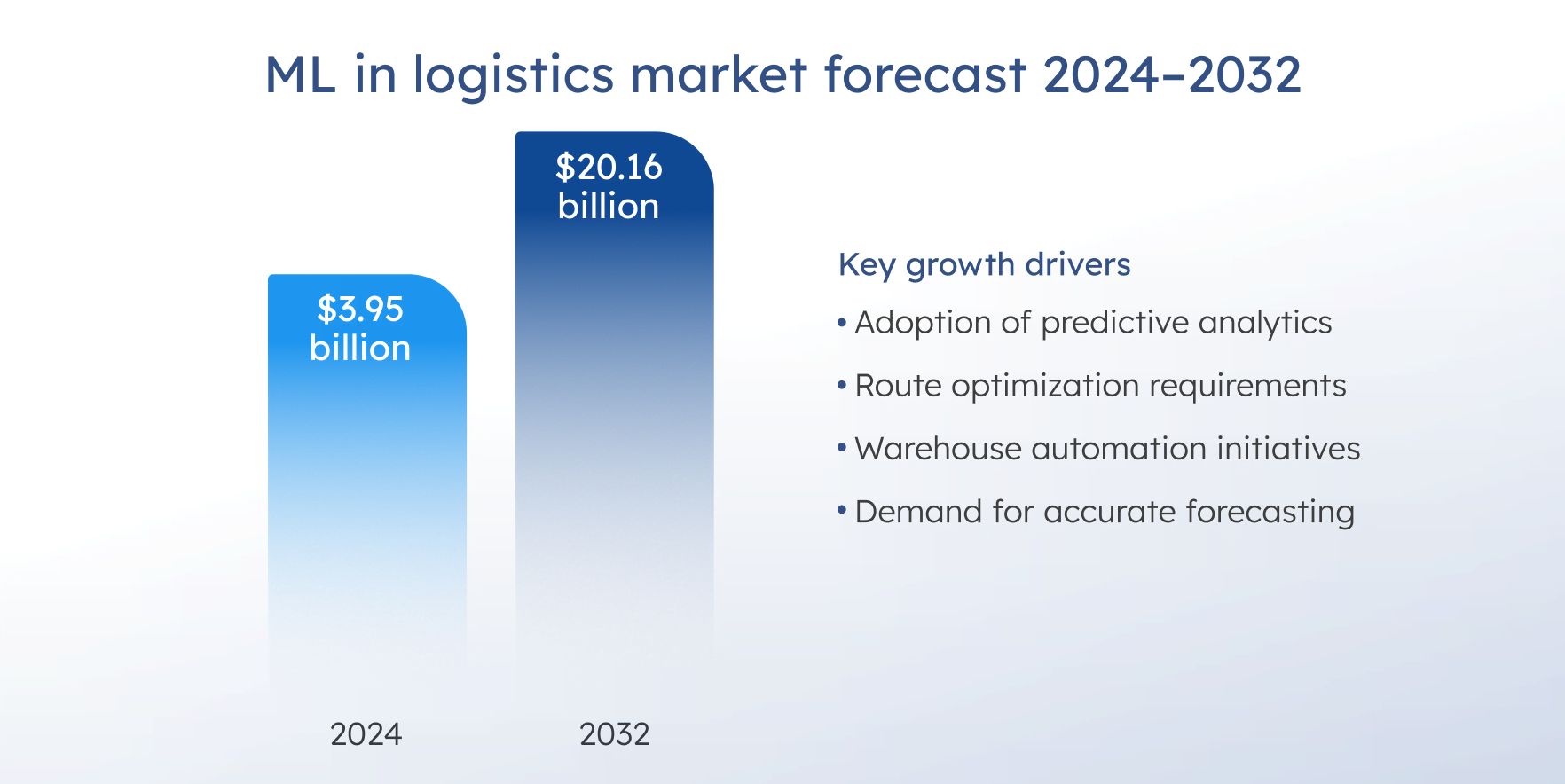
Machine learning in logistics market forecast (2024–2032). Source
Improvements that ML brings to logistics usually create positive effects throughout the supply chain. Research shows that companies with the most mature supply chains and that invest heavily in technologies like AI and GenAI are 23% more profitable than their peers. They also delivered 15% better returns to shareholders. Nevertheless, the average supply chain maturity score across all leading and other organizations remains comparatively low at 36%.
Large enterprises are leading the digital transformation in logistics, while smaller ones (less than $500 million in revenue) are lagging due to high implementation costs and more cautious investment.
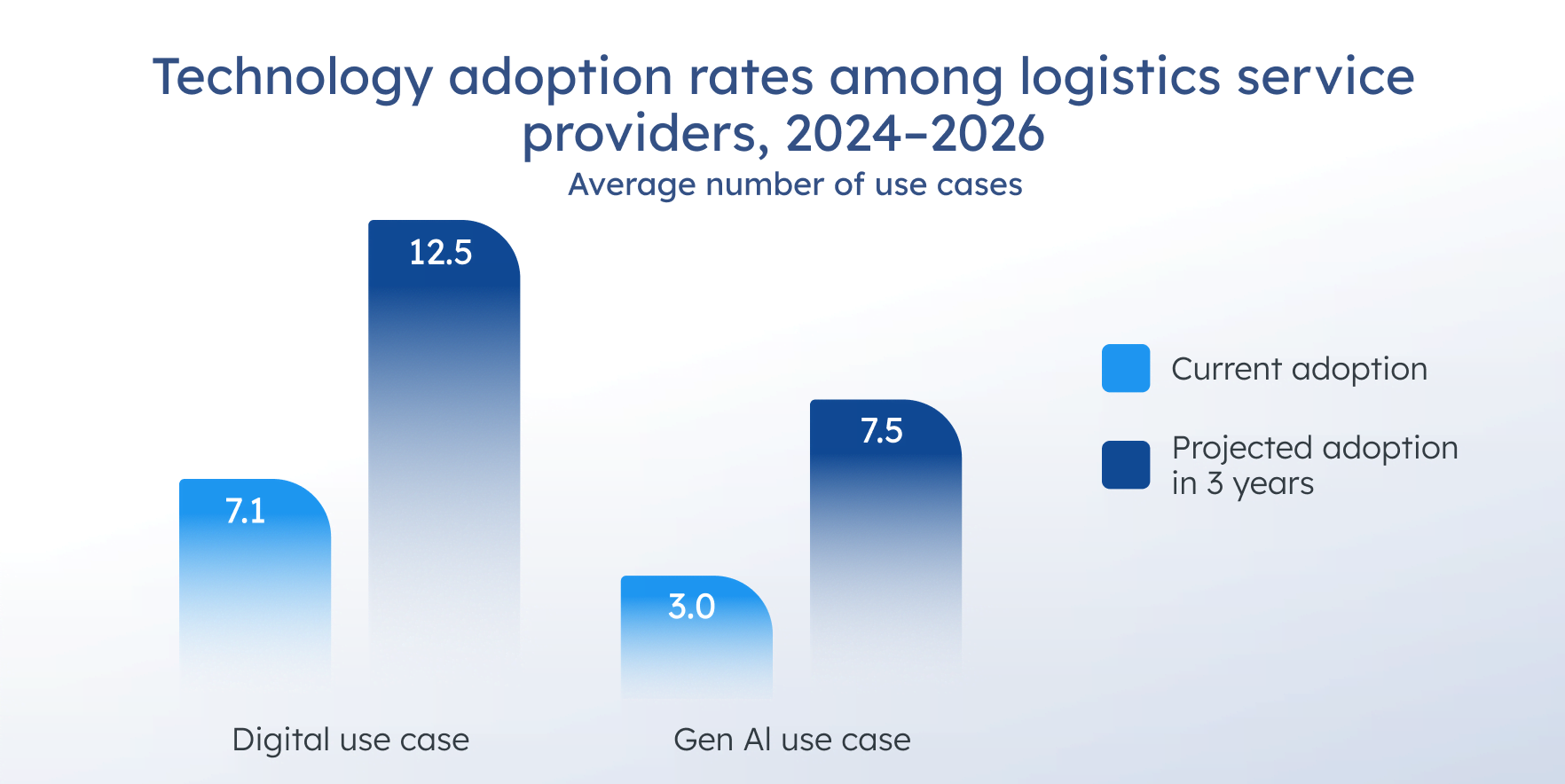
Technology adoption among logistics service providers (2024–2026). Source
9 key use cases of ML in logistics
In theory, ML has a positive impact on business profitability, growth, and competitiveness. But here’s what it actually does in practice.
1. Warehouse management
From inventory optimization to workforce planning, ML helps organize storage and operations as efficiently as possible. It can recommend where to place an item, what its storage conditions should be, or when it should be restocked. When combined with computer vision, it can also check for package defects and item damage, and automatically count inventory.
Smart algorithms also optimize staffing levels around predictable demand spikes such as holidays, Black Friday, or weekends. They support scheduling systems based on forecasted demand, ensuring no overstaffing during off-peak periods and sufficient warehouse personnel when needed.
GXO Logistics has launched an AI-powered robot for automated inventory reporting. It navigates the warehouse’s physical complexities and can scan areas up to 13 meters high at a rate of 10,000 pallets/hour. The solution helps the company to optimize available space, provide more accurate inventory control, and, as a result, deliver better customer service.
2. Inventory management
Among all logistics management software, ML-powered inventory management systems are the most directly tied to improvements for working capital and customer service. The core value is not mere inventory counts, but the decisions on ordering. By analyzing data, ML models can suggest what to order, when, how much, and where to place it. They reduce storage costs and waste by managing stock levels, ensuring end users receive products in the right quantities and at the right time.
The research shows that ML models achieve a 15% increase in demand-planning accuracy, a 10% reduction in overstocks and stockouts, and 8% fewer replenishment errors. The overall accuracy in predicting order fulfillment timelines reached 95%, leading to improved delivery times and higher customer satisfaction.
3. Route optimization
ML algorithms evaluate multiple factors, such as traffic, weather conditions, and vehicle capacity, to select the best route and minimize driving time, and, subsequently, fuel consumption. They create paths for delivery vehicles to avoid obstacles such as traffic jams, road maintenance work, and other urban disruptions. Improved transportation management helps not only to save operational costs, but also lower environmental impact.
For example, UPS’s ML-powered app ORION enables savings of 2–4 miles per driver through route optimization. Other research estimates that AI-powered route planning can reduce CO₂ emissions and fuel usage by 15–30%. Unlike traditional shortest-path approaches, modern route optimization with ML considers multiple factors such as time, reliability, fuel costs, service-level penalties, and driver constraints.
4. Shipment tracking
Using different types of data analytics, ML systems shift shipment tracking beyond answering the question “where’s the package?” to complex decision support. It allows not only to estimate its next checkpoint or arrival status, but also assess whether it is likely to be delayed and what action can be taken to prevent it. Moreover, algorithms can accurately predict delivery times, detect shipment anomalies, and suggest better routing.
Today, AI/ML-driven platforms for real-time transportation visibility can improve the estimated time of arrival by 32%, even two days before a planned delivery. More precise estimates have led to a 25% reduction in late penalties and a 30% reduction in dwell times.
5. Fraud detection
By learning from historical and real-time data, ML models can detect anomalies, suspicious activities, and unusual stop patterns quickly, before they cause severe damage. For the logistics industry, they help uncover suspicious order values, coupon abuse, fake orders, and identity fraud.
Furthermore, ML algorithms can identify new fraudulent activities, allowing logistics companies to build advanced fraud detection strategies and more efficiently protect customer data. Luckily, AI models can help combat unauthorized activities. AI fraud detection frameworks show a high level of precision: research highlights 93% accuracy for hybrid AI architecture (supervised learning models + unsupervised learning techniques), along with an over 90% recall rate for both known and emerging fraud patterns.
6. Risk management
By collecting and analyzing large volumes of data, ML models can estimate the probability of risk, calculate timing of potential disruptions, and evaluate the impact. They assess operational challenges such as vehicle delays, warehouse congestion, and missed deliveries, supporting decision-making and risk mitigation strategies. For example, anticipated transportation delays due to weather conditions enable managers to reroute shipments en route or use multimodal options instead.
The studies show that Gradient Boosting ML models yield the most reliable outcomes for risk management cases, with an overall accuracy of 94.2%, surpassing Random Forest (91.8%) and Support Vector Machine (89.6%). The researchers highlight the efficiency of ML in logistics and supply chain management for risk management and proactive decision-making.
7. Demand forecasting
Demand prediction based on ML algorithms allows logistics companies to analyze historical data and changing market trends to project customer demand, avoid overstocking or stockouts.
Demand estimation models analyze demand and customer behavior by examining price signals, behavioral metrics, and product lifecycle data. Additionally, such systems consider external factors that can influence demand, such as weather or local events.
ML demand forecasting models can produce more reliable projections than traditional ones. The prior considers a wide variety of real-time factors, while the latter processes only historical data. With more factors analyzed, logistics companies can better prepare for sudden demand increases or drops.
Amazon implemented its AI demand forecasting system to predict what, when, and where customers want to buy products. The newer model considers not only historical sales data, but also weather patterns, holiday schedules, and regional differences. This improved regional forecasting by 20% for millions of items. Moreover, the forecasts from the new model have improved long-term national predictions of deal events by 10%, which can reasonably translate into hundreds of millions of dollars.
8. Predictive maintenance
A powerful combination of IoT and ML enables logistics providers to detect early signs of machinery degradation, imbalance, or overheating and address issues promptly. This technology blend moves maintenance from repair and replacement to condition-based servicing, minimizing vehicle downtime and reducing repair costs. With ML capabilities, companies prevent equipment failures and operational disruptions through fleet wearout monitoring and failure prediction.
The research shows that predictive maintenance can reduce fleet downtime by up to 50% and reduce maintenance costs by 40%. The findings indicate that the application of ML in predictive maintenance significantly improves fleet reliability and logistics efficiency.
9. Robotic delivery and warehouse robotics
For robotic delivery, whether it’s last-mile or short-distance transport of goods, AI and ML enable autonomous vehicles to navigate safely, recognize pedestrians and obstacles, and determine the best path to the destination. This way, ML helps logistics companies reduce costs associated with labor, fuel, and last-mile inefficiencies.
In warehouse operations, robots accelerate parcel sorting, inventory identification and cataloging, and damage detection. For example, by the introduction of AI-powered sorting robots, DHL achieved a 40% increase in sorting capacity. With the help of ML and computer vision, robots can sort 1,000+ small parcels per hour with 99% accuracy.
Benefits ML can bring to logistics companies
The outcomes that machine learning brings to logistics are solid, measurable, and time-proven.
Operational efficiency
The introduction of AI and ML in logistics processes helps minimize human-error risks, optimize energy consumption in warehouses, define optimal routes and truckloads, and reduce waste related to incorrect storage or transportation conditions. Industry leaders anticipate that 60% of supply chain disruptions will be resolved without human interference by 2031.
Cost reduction
In logistics, AI systems can help businesses achieve 15% cost savings. Among the factors that drive this gain are a 35% decrease in inventory, up to a 20% improvement in delivery reliability, and a 65% reduction in lost sales due to inventory optimization. Moreover, ML support of real-time shipment tracking leads to fewer delays and penalties, while smart routes lower fuel consumption.
| Category | How AI/ML helps | Example of savings |
|---|---|---|
| Fuel costs | Route optimization, idle-time reduction, traffic prediction | Fewer miles driven, less fuel burned |
| Labor costs | Warehouse automation, workforce scheduling, task optimization | Fewer overtime hours, higher productivity |
| Operational costs | Better asset utilization, automated decision-making | More deliveries per truck, fewer empty trips |
| Inventory holding costs | Demand forecasting, inventory optimization | Less excess stock sitting in warehouses |
| Spoilage and waste | Monitoring temperature-sensitive goods, demand prediction | Reduced food, pharmaceutical, or perishable waste |
| Damaged goods | Computer vision inspection, better packing recommendations | Fewer damaged shipments and insurance claims |
| Energy costs | Smart warehouse energy management | Lower HVAC, lighting, and refrigeration expenses |
| Penalty costs | ETA prediction and compliance monitoring | Reduced late-delivery fines and service penalties |
Data-supported decisions
Predictive analytics and external data analysis help make better decisions based on real-world conditions, not guesswork. ML algorithms find correlations, patterns, and demand signals, uncovering operational inefficiencies and market expansion opportunities. With better planning and management, companies save time and money and reduce risks. The experts predict that 25% of logistics KPI reporting will be held by GenAI to support strategic planning by 2028.
Better customer experience
ML helps optimize shipping times, enables real-time parcel tracking, and personalizes the delivery experience. Proactive notifications about parcel delivery delays, for example, increase customer trust and reduce complaints, while AI chatbots and virtual assistants reduce support wait times and generate instant, contextual answers.
Scalability and adaptability
Predictive analytics and advanced forecasting improve companies’ ability to adapt to shifting economic conditions. Market volatility is no longer a temporary disruption but a structural part of modern supply chains, so businesses need to adapt faster to stay competitive. The survey highlights that 53% of respondents say they use AI in a few areas or widely to predict disruptions. Similar results are for the scenario planning and operational transparency: here, 55% of interviewees say they use AI in a few areas.
Greener business
AI tools for smart routing and warehouse operations lead to lower resource consumption and reduced waste. By defining the best routes and estimating optimal cargo loads (meaning fewer unnecessary kilometers driven, fewer trips, and fuller trucks), ML helps organizations to reduce CO₂ emissions by 10–15%.
The main challenges of the ML implementation in logistics
Even though every business is unique, there are several common challenges that almost every logistics company faces when it comes to ML adoption. Let’s look at the main ones below.
Poor data quality
ML algorithms coupled with big data in logistics rely heavily on accurate, consistent, and clean data. They require uniformity in categories, units, and encoding; otherwise, the model will learn misleading patterns, struggle to generalize, or fail in real-world use. Logistics businesses that store data in isolated legacy systems would likely face difficulties implementing AI and ML-powered solutions due to fragmented, inconsistent, and incomplete data.
Data quality remains the main barrier for AI adoption worldwide. The recent global survey shows that 40% of the respondents name data quality and integrity issues as a significant ROI factor for AI initiatives. At the same time, 56% of chief supply chain officers report AI integration with legacy systems as the major challenge to successful AI and ML implementation.
If you have the same problem, it’s not too late to improve. Luckily, there’s no need to fix anything at once. You clean only the data that brings real value. Select one business problem, for example, route optimization. Then define the minimum data you need for the path optimization algorithm to make good decisions. Now, create a centralized layer for that data and add validation rules at the source. Finally, continuously improve data quality to get reliable ML model outputs.
AI alignment gap
Research from an analytics and optimization organization shows that 30% of logistics specialists report a lack of engagement from senior executives when implementing AI and ML strategies. At the same time, in Gartner’s survey, only 23% of responders say their company has a formal AI strategy. The stark disconnect between leadership vision and operational reality, along with unclear AI strategies, is another core reason for slow ML adoption.
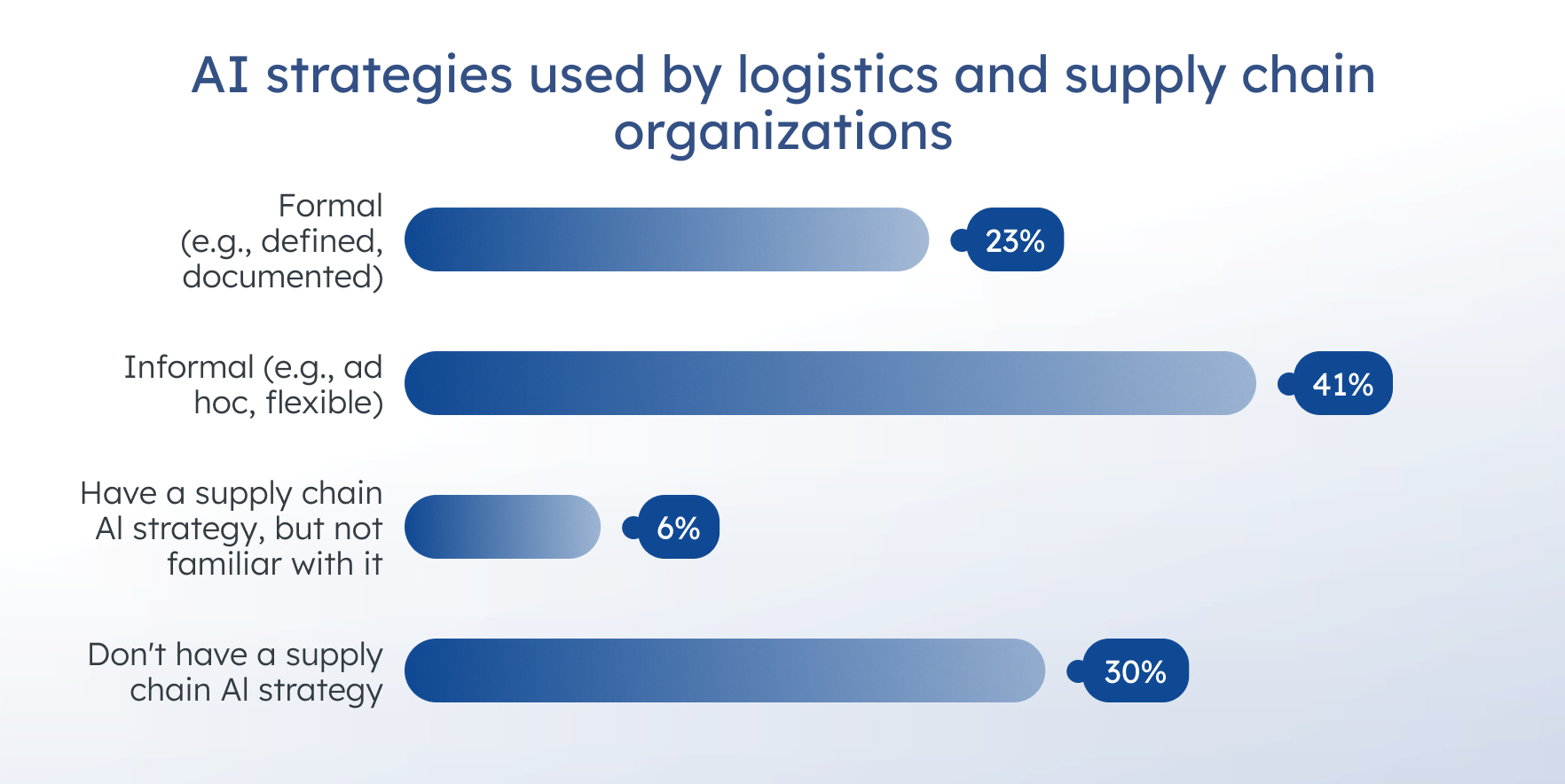
Types of AI strategies used by logistics and supply chain organizations. Source
When it comes to strategic alignment, organizations often fail to coordinate between operations, IT, and AI teams. With no strategy or business ownership, many AI initiatives become isolated PoCs or models that never enter production workflows. What makes this important is that in the logistics business, the cost of failure is high. In contrast to marketing analytics, failures in ML-powered logistics analytics tools have physical consequences, such as delayed shipments, spoiled goods, and contractual penalties.
To avoid a false start, instead of focusing on the question “Where can we implement ML?” concentrate on assigning clear ownership at every high-value decision. Then decide which process you want to optimize with ML. You don’t need the full automation at this stage. Let the algorithm suggest actions, but leave the decision to humans. Set KPIs and success criteria for each model’s decision, integrate in real workflows, then measure business impact and select what works. This way, you get a single shared focus for the teams, a single owner per decision, and a single shared metric.
Security and compliance considerations
Unlike physical threats in logistics, such as goods theft and vehicle hijacking, ML models in logistics pose data security and model integrity risks in the first place. As the system handles information about payments, warehouse telemetry, shipment routes, and delivery addresses, it can easily become a desirable target for hackers.
There are several attack surfaces in AI logistics systems, including data at rest and in transit, data leakage through an ML model, and exposure of IoT devices. Harmful strategies also vary. Some malicious techniques, such as API exploitation, are aimed directly at data theft. The others, like data poisoning and adversarial inputs, are intended to mislead and degrade models. In that case, businesses get the opposite of what they wanted to achieve: inaccurate demand forecasts, inventory over- and underestimates, and poor sourcing decisions.
In addition, modern regulations demand a high level of security and data safety, as well as AI governance, operational resilience, model auditability, and explainability. The failure to meet the requirements leads to fines reaching thousands of dollars, SLA breaches, and customer churn.
Adoption costs and skill shortage
Businesses may struggle to implement machine learning in logistics due to financial reasons. As ML systems require robust data collection, integration, and processing, the price tag for initial deployments ranges from $10,000 to $50,000. Scaled enterprise systems, in turn, require more time and effort, so ML development for them can be as high as $100,000+.
The lack of skilled specialists on the market exacerbates the problem. Over 90% of supply chain and logistics companies report having at least one major skills gap in their staff. As expected, the respondents identified AI and automation as the largest capability shortfall, with a solid 47% reporting it. A Gartner survey found that 50% of chief supply chain officers say they lack domestic expertise/talent to implement and manage AI.
If you have limited resources but still want to benefit from ML, start small with high-ROI, low-integration areas. Avoid big band deployments. Instead, proceed gradually from pilot to expansion, and only then scale. This way, you’ll be able to save money on models that fail in real-world use beyond pilots.
Weak change management
Technology adoption often affects current business workflows, decision-making, planning, and control. In the operationally sensitive environment that logistics is, it’s vital to adjust processes quickly to avoid duplicate decision systems. When ML systems aren’t properly embedded into decision workflows, they become underused and degrade over time. It creates a situation where there’s no trust in the model’s outcomes, and people continue relying on legacy planning tools and human planners.
Poor ML integration into the workflows substantially reduces ROI from such systems due to operational inefficiencies. Poor change management also leads to the loss of trust in the model’s outputs, as employees don’t understand or cannot validate the system’s recommendations. It leads to frequent manual overrides and cancels out expected gains from automation.
To avoid a change management trap, companies should first rethink how decisions are made, how exceptions are handled, and how work flows across systems, rather than focusing on the tool. Next, make an ML solution the operational baseline by embedding its inputs directly into enterprise systems. Finally, build trust in model outputs by showing how the algorithm works and tracking performance.
Machine learning supporting technologies
Machine learning is not a standalone field when it comes to its application in logistics. Here are the most notable auxiliary technologies.
Predictive analytics
Predictive analytics is widely used by Amazon and Walmart, which have wide, logistics-heavy distribution networks. It can work for the smaller businesses as well, providing risk assessments, predicting demand, and supporting dynamic inventory allocation.
If you have enough quality data, forecasting models can optimize routes, predict vehicle or equipment failures, and improve estimated delivery times. Put together, you get:
- Optimized inventory level with no stockouts or overstocks
- Cost savings on fuel and routine vehicle maintenance
- Reduced downtime and fewer emergency repairs
- Better supply chain visibility and customer satisfaction
Computer vision
With computer vision, machines can “see” and interpret video/images, which has proven very helpful in warehouse management and robotic delivery. Combined with ML algorithms, cameras can track inventory levels, detect misplaced items, and empty shelves. Moreover, vision systems can automatically detect package deformation and leaks.
When it comes to robotics in logistics, computer vision is widely used in navigation systems, helping food delivery robots detect roads and sidewalks, avoid obstacles, and recognize the delivery target. The same is true for warehouse robots, which help navigate dense indoor environments with shelves, pallets, and people. With computer vision, businesses gain:
- Accelerated scanning of packages and shipping labels
- Improved accuracy in shipping, item picking, and labelling
- Lower operational costs through visual tasks automation
- Enhanced last-mile delivery and safe package handoff
IoT
When it comes to specific storage and transportation conditions for fragile, perishable, or hazardous goods, the Internet of Things helps to control the environment and prevent spoilage, damage, or compliance violations. By capturing temperature, humidity, shock, and tilt, smart sensors relay this information to rule-based systems that then regulate these conditions or trigger alerts.
Another application area for IoT in logistics is fleet management optimization. Here, the key benefits of introducing IoT include improved efficiency, lower fuel consumption due to reduced engine idling in traffic, less stop-and-go driving, and fewer kilometers driven. Sensors can also encourage safer driving behavior through continuous monitoring and feedback.
Finally, logistics businesses use IoT technology for predictive maintenance, preventing sudden downtime in vehicles and warehouse equipment, and reducing costs by minimizing reactive and scheduled maintenance. The outcomes include:
- Greater shipment visibility and reduced delays
- Cold-chain temperature compliance
- Improved warehouse inventory accuracy
- Theft/loss prevention and safer driving practices
NLP
In contrast to the abovementioned technologies, natural language processing does not directly influence storage or transportation – its role is a lot more subtle. NLP helps automate customer support by handling inquiries about shipment tracking, processing claims, and answering FAQs. Voice-based warehouse assistants enable hands-free operations, providing picking instructions and inventory lookup on request.
For supply chain intelligence, NLP systems can analyze news, reports, and emails to identify potential risks and disruptions. For example, the news feed says that Factory A was shut down due to heavy floods. The NLP system’s output would predict delays from that supplier. It would further assign the risk score for this event and define the affected SKUs, enabling the business to decide on sourcing, rerouting, or other actions.
NLP solutions can analyze shipping contracts and regulations to support compliance and identify risks, obligations, and ambiguities. All in all, logistics companies get:
- Reduced manual document processing
- Automated customer support
- Fewer compliance violations
- Smoother coordination across the supply chain
What’s worth noting is that all these technologies yield the greatest gains when combined with artificial intelligence and machine learning. Modern intelligent warehouses become near-autonomous fulfillment centers through the balanced use of AI, ML, predictive analytics, CV, IoT, and NLP.
Conclusion
Machine learning in the logistics industry has a variety of applications, from warehouse management to dynamic route optimization and demand forecasting. By analyzing historical and real-time data, ML models can take into account a host of factors to predict risks and shipment delays, and to avoid overstocks and stockouts. The technology allows businesses to cut costs, streamline planning, and gain a competitive edge through improved operational efficiency.
On the path to ML adoption, logistics companies face the most frequent adoption cost challenges, followed by a lack of high-quality data and a skills shortage. While organizations are ready to adopt the technology, they often fall short of defining clear application areas and the goals they want to achieve with it. Misalignment between teams results in wasted investments, as ML models built without proper coordination may never reach production.
Finding the right ML engineers and data scientists for your ML project is a complex and tedious process. An established software development company can help you find the right talent fast and assemble a team of ML professionals. Get in touch and schedule a free consultation on your project.






Comments