
Whether you’re googling, using AI, or asking your network about B2B website development cost, you can get anything between $500 and $100,000+. It doesn’t add much clarity – frustration only. Why is the price difference so large? How much will it really cost the business?
The truth is, all these numbers are correct. Still, the total amount depends on a variety of components, derived from your requirements and needs. Discover the key factors that influence B2B website costs and draw up a realistic budget.

Key highlights
- An expert-built B2B website is a valuable asset of your company. It reflects your brand identity, offerings, and expertise, helping to convert businesses into customers.
- The main cost factors for B2B sites include development model, complexity, and branding level. Integrations, cloud services, and licenses represent supporting costs.
- Operational costs can also emerge from plugins, technical maintenance, CMS licenses/ website platform fees, and should be considered in advance.
- To get a cost breakdown of your B2B site you can consult with professional web developers or use our team cost calculator if you know the exact project scope.
Why you need a good B2B website
First thing first, let’s define what a B2B website is. A business-to-business website is an online platform that helps companies sell and buy goods and services to other businesses. The prominent examples of B2B websites include ecommerce platforms, marketplaces, service provider websites, and SaaS platforms. They enable businesses to provide product or service information, attract customers, generate leads, and build long-term relationships with clients.
Before going into B2B website development pricing, it’ll be useful to contemplate why you need a professional website in the first place. We won’t deviate from the topic to discuss DIY solutions for $500 or low-code platforms that let you build a viable solution for $5,000, offering simplicity at a modest price tag. Instead, we’ll focus on robust websites for established businesses.
Professional appearance
A B2B website should translate reliability, professionalism, and expertise to attract new customers. To do so, it must have a good look and feel, be fast, and easy to navigate. You can achieve it through well-thought-out user paths, custom design, and outstanding performance, which means you cannot bet on doing everything quick and dirty.
Customer acquisition
The B2B niche’s main goal is to capture interest and, in turn, convert other businesses into customers. From this POV, a website is an important investment and a part of a marketing strategy that generates revenue and delivers high ROI. The point is that a website with a cluttered homepage or slow load times likely won’t bring you any leads, so you need a reliable solution.
Lasting trust
The B2B model implies being in it for the long haul. Potential clients don’t come at once – they compare options, check testimonials, and assess case studies, so the final decision often comes after weeks or months. In complex, multi-step sales cycles, it’s vital to have a website that provides visitors with useful information and dispels their doubts.
Overall, building a fully custom or highly customized B2B website is a great investment for SMBs and enterprises. When done right, it works for your brand, creating trust, demonstrating credibility, and increasing conversions.
Defining how much does a B2B website cost
There are several approaches to rough B2B website costs estimates. We’ll look at the two most common.
By project size and complexity
In a website development project size often goes hand in hand with complexity. Of course, there will always be small but complex projects, but they are not so common.Their cost should be discussed directly with the software development service provider. Here are the approximate price ranges for typical ones.
- An average cost of a small project with core features, basic branding, and few integrations would be $5,000–$10,000 – a great fit for early-stage B2B companies.
- An average-sized project would cost $10,000–$25,000, and include custom page design, advanced forms, and accessibility basics. Good choice for SaaS marketing sites.
- Advanced B2B websites can cost $50,000–$75,000+. Such projects suit large B2B ecosystems and demand robust integrations, custom branding, and advanced analytics.
- High-end websites can cost over $100,000. They usually have complex architecture, extensive features, and custom design, serving the needs of large corporations.
By website development model
A website has the two main components: the frontend/backend part and a content management system (CMS). Any or both parts can be fully custom or created with the help of specialized platforms and out-of-the box solutions. Let’s look at the main combinations.
- Platform with built-in CMS. Widely used for its versatility and customization capabilities, websites built by such a model are easier to create and fast to launch. Such platforms are flexible and provide maintenance, updates, and automatic site backups.
- Custom website + pre-built CMS. When organizations need a website with complex business logic or design freedom, yet their content management needs can be covered by ready-made CMS, this model fits best.
- Hybrid SaaS platforms. Such solutions blend CMS, CRM, and marketing capabilities, offering a plethora of features. Work best for creating marketing-heavy B2B sites of medium-to-large companies.
- Custom website + custom CMS. The most expensive option for large enterprises or tech-driven B2B platforms that value full control over the website and have unique performance, security, and scalability needs.
Here’s a breakdown of the common B2B website development models, their characteristics, and typical costs.
| Model | Examples | Typical price range | Core cost factors | Notes |
|---|---|---|---|---|
| Platform with built-in CMS | WordPress with standard template, Webflow | $3,000 – $50,000 | Design Pages Integrations CMS plan | Most common for marketing B2B sites. |
| Custom website + pre-built CMS | React + WordPress, Next.js + Strapi | $10,000 – $100,000+ | Frontend complexity Features Content CMS integration | Ideal for mid-to-large B2B companies. |
| Hybrid SaaS platforms | HubSpot CMS, Salesforce Experience Cloud | $5,000 – $100,000+ per year | Subscription tier Template customization Integrations Automation Features | Includes hosting, CMS, CRM, marketing automation. |
| Custom website + custom CMS | Enterprise portals built from scratch | $50,000 – $250,000+ | Architecture complexity Tech stack Integrations Design | For large enterprises needing fully custom functionality and workflows. |
B2B website development cost factors
Business-to-business website costs are not guesswork; they correspond to a set of features, parameters, and configurations your organization needs. Here are the core elements that influence B2B website development estimates.
Design and branding
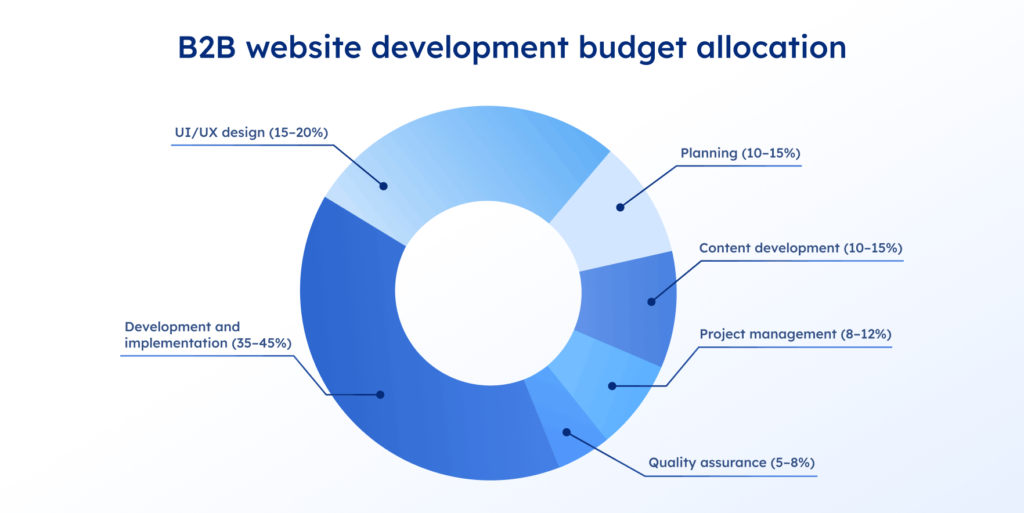
Website development costs strongly correlate with the level of customization you need for your site. The more creative work, custom layouts, and complex forms you need, the higher the price will be. Normally, UI/UX design consumes 15–20% of your development budget. Design expenses for a small B2B website development start at $3,000 and include light branding, 5–10 pages, and a simple structure.
Since it takes website visitors less than 0.2 seconds to form the first impression of your business, this impression should be strong. Whether it’s modifying default templates on website platforms or building pages from scratch, you need experienced web designers to help your brand stand out.
Features and functionality
Your B2B website’s core capabilities are the major cost driver in the development project. More complex business logic and a robust feature set require more time and money to build. The core functionality includes data processing, custom APIs, workflows, and forms, as well as internal admin tools and account management. As 75% of B2B buyers opt for a rep-free sales process, many organizations also build customer web portals on their websites to meet those expectations.
When poorly planned, this factor can significantly inflate your budget, so careful feature prioritization and alignment with business goals are essential to avoid going beyond the numbers.
Technical requirements
Technical requirements go beyond features and include security, integrations, and scalability requirements. B2B sites are usually connected with CRMs, ERPs, marketing tools, analytics, and payment systems. These are vital integrations for many businesses that allow them to manage and nurture leads, make secure transactions, and monitor website performance.
Security and compliance requirements depend on your industry and the type of data collected, and generally include compliance with GDPR, HIPAA, PCI DSS, SOC2, and the use of best practices such as secure authentication, role-based access, and data encryption. Scalability, on the other hand, refers to how easily your website can expand and integrate new tools. Consider cloud infrastructure for easy scaling and workload balancing.
CMS integration/development
As mentioned before, you can either choose a pre-built CMS or develop one from the ground up. The first option requires careful selection, feature and pricing comparisons, and a check of business fit. Still, subscription removes the need for your business to issue updates, security patches, and new functionality. Custom CMS is rarely a viable option for most businesses due to its high costs and the need for regular maintenance and updates.
WordPress remains the most popular CMS system globally, with a solid 60% market share. Other widely used CMSs include Wix, Squarespace, Joomla, and Webflow. Overall, ready-made CMSs offer varying prices, suit various company types, and offer a wide range of functionality. When it comes to expenses, you choose between high upfront costs and small, but recurring fees. The majority of businesses prefer third-party CMSs for their fast deployment and ease of use.
Content and SEO
Content and SEO often go hand in hand with B2B website development, so they are worth mentioning as cost factors. During upfront cost calculations, you need to consider whether you create content, rewrite it, or migrate it. Here’s the breakdown with approximate pricing.
| Website size | Number of pages | Content creation costs | Notes |
|---|---|---|---|
| Small | 5–15 | $1,500 – $5,000 | Simple brochure sites, core pages; minor SEO. |
| Medium | 15–50 | $5,000 – $15,000 | Service/product pages, some case studies; SEO optimization. |
| Large | 50–200+ | $15,000 – $50,000+ | Complex B2B content; deep SEO strategy. |
Keep in mind that not all website development companies offer content creation or optimization services – ask about it in advance. Full-service agencies usually offer content creation and SEO as part of website development. Other vendors don’t include it by default, but they can partner with copywriters or marketing consultants. Finally, sometimes you just need to handle content separately.
Software development team
Another factor that can significantly reduce or increase your costs is the developers’ hiring model. In a world where developers’ hourly rates vary from $25 to $150, you can find opportunities where you can get quality results at a reasonable price.
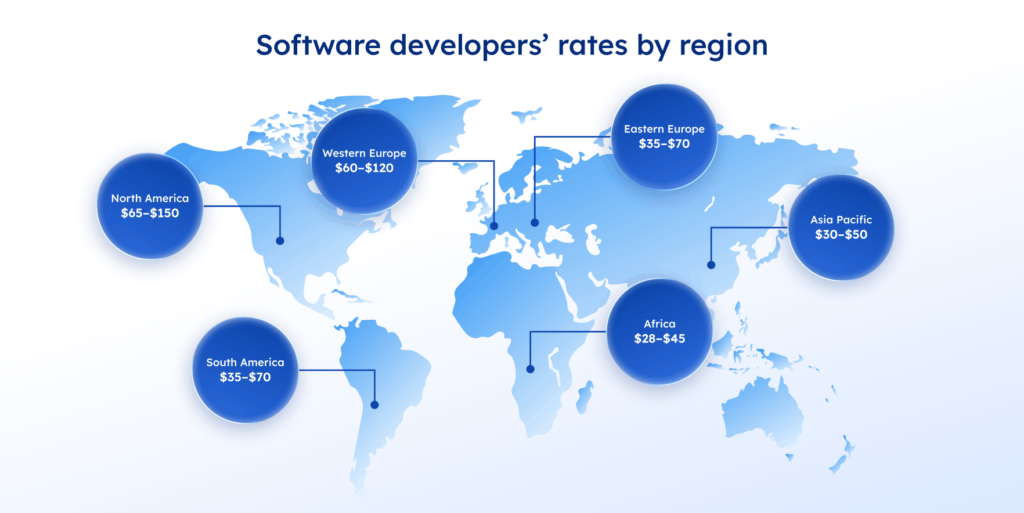
The in-house team is the most expensive model, as you need to pay salaries and benefits and provide office space, hardware, and software required for development. Nevertheless, it gives you full control over the work and allows you to manage the project directly.
Hiring freelancers can work well for small businesses and startups. They are good for short-term projects and are cheaper than full-time employees. Yet, there’s no guarantee that work will be done on time or that a freelancer will be available during your business hours.
Outsourcing is the optimal value-for-money alternative. When chosen correctly, it helps reduce development costs without sacrificing quality, so nearly 68% of enterprises favor this option. You can hire a dedicated development team for your end-to-end B2B website project and get a transparent development process and clear deliverables. Still, you need to meticulously select the outsourcing partner to get the most from this model.
Not sure how much your B2B website or B2B portal development will cost? Try our team cost calculator to get a ballpark estimate.
Calculate the cost of your B2B website development team
Ongoing activities
Owning a B2B website means you’ll always have some ongoing costs, smaller than the development itself, but regular. B2B websites must be monitored and updated regularly in order to stay relevant and functional. Such activities include:
- Technical maintenance
- Performance monitoring
- Security monitoring
- Updates for custom websites
If you have chosen outsource development for your website, you can also ask your service provider for post-launch support. Although using a web platform means shared responsibility for ongoing maintenance, it’s always better to have a developer available for custom code fixes or emergency troubleshooting.
| Component | Details | Typical annual cost |
|---|---|---|
| Technical maintenance | Updates to CMS, server patches | $2,000 – $10,000 |
| Security monitoring | Malware scans, firewall, backups | $500 – $3,000 |
| Performance monitoring | Speed, uptime, and error monitoring | $200 – $2,000 |
Our experience shows that the annual run rate of maintaining a B2B website analytics and BI systems can range anywhere between $5,000 to $500,000, depending on the size, complexity, and variability of the sales pipeline.
B2B website’s ROI shouldn’t be evaluated in isolation
In most cases, the primary objective of a B2B website is not brand visibility or passive information delivery, but systematic lead conversion tied directly to revenue generation; accordingly, return on investment becomes the governing performance metric.
However, ROI in a B2B context requires contextual evaluation — it is an output variable that depends on disciplined tracking of upstream operational metrics such as lead acquisition cost, total number of leads generated, lead conversion rate across funnel stages (visitor-to-lead, MQL-to-SQL, SQL-to-close), average deal size, and ultimately customer lifetime value. These inputs determine customer acquisition cost, pipeline velocity, and revenue predictability, all of which directly influence ROI.
Without this integrated metric architecture, leadership is left with directional data rather than financial clarity. Therefore, organizations must implement robust analytics and business intelligence frameworks that connect marketing automation, CRM systems, and financial reporting into a closed-loop measurement model.

Hidden costs of business website development
Hidden costs might not be so much hidden, indeed, but are the ones you don’t think about in the first place. They are commonly not included in quotes from outsourcing software development companies. Still, you need to consider them to accurately estimate your budget and total cost of ownership (TCO).
- Web hosting. Depending on its type, it can cost from $3–$20 to $100–$500 per month, depending on your traffic volume, website performance, and uptime requirements.
- Cloud hosting. Suitable for websites with high traffic volumes that need to dynamically scale. Can cost from $30 to $5,000 per month depending on required resources.
- SSL certificates. Billed annually, secure sockets layer certificates can be obtained for free, but the common pricing range is from $5–$25 to $1,500+ (for enterprise solutions).
- Website platform fees. If you opted for WordPress or Webflow, you pay yearly fees according to the selected pricing plan, themes, plugins, and advanced features.
- Third-party integrations and plugins. Unplanned connections, additional tools for advanced analytics, firewalls, or chatbots can add up costs to your initial budget.
- CDN and caching. Content distribution networks can be free, have a pay‑as‑you‑go basis, or include subscriptions with new features or support packages.
- CMS fees. Standalone CMS solutions often have pricing tiers, differentiating by features and content volumes. For different solutions the price can vary from $15 to $2,000+.
Note: Although an open source CMS can sometimes be a cost effective solution, it is rare when it does not require significant customisation efforts leading to high integration and maintenance costs.
Tips to optimize your B2B website budget
There are several ways to cut the initial development budget and post-launch costs. The key to success, in essence, is thorough planning and strong project leadership.
- Prioritize features. Reduce uncertainty in your project by applying feature-prioritization techniques, such as the MoSCoW method or the Value vs. Effort approach.
- Define a clear scope. Clarify all features, functionality, and integrations your B2B website needs before the project launch to avoid scope creep during development.
- Plan for growth. Make your website scalable at the outset to evade costly upgrades or code refactoring later.
- Organize your content. Structured content helps reduce design and development costs, minimize content creation costs, and accelerate stakeholder approval.
- Start with simplicity. You don’t need to launch a $100,000 project at once. Begin with an MVP that includes core features and functionality, and then grow it incrementally.
- Prepare for the unexpected. Don’t let unforeseen events slow down your project. Get a contingency fund (10–25% of the initial budget) for sudden technical or design issues.
Conclusion
B2B website development is a long-term investment that allows you to attract more leads, shorten sales cycles, and build trust with your customers. Professional website costs can range from $5,000–$10,000 for a small project to $100,000+ for complex, enterprise-grade solutions. The exact spending will depend on the development model and requirements for customization and functionality. In addition, you should consider the hiring model of web developers, content requirements, and post-launch activities.
If you need help assessing your project, contact us and get a free consultation. We’ll discuss your business needs, provide an overview of project requirements, and deliver a project estimate based on our rates and 18 years of website development expertise.






Comments