API Development and Integration Services
We build high-performance APIs and efficient API infrastructures that adapt to evolving business needs. Whether it is REST, SOAP, GraphQL, or other types, our experts will do it right.
Our end-to-end API development services
01
API consulting
SoftTeco helps businesses to decide on API style, architecture, and tools. Our developers create an API delivery roadmap, crafting a strategy that aligns with your company’s objectives and helps contain development costs.
02
Custom API development
Our API development company builds dependable, resilient, and cloud-ready API solutions that fit your systems from day one. By applying best practices and industry standards, we ensure you can easily integrate your software with other applications, devices, and business solutions.
03
API design
The development team models resources and their relationships, chooses between resource- and action-oriented endpoints, as well as designs an error response contract. We develop pagination strategy, filter and sort conventions – all well documented and with security in mind.
04
API integration
We connect your system to third-party services, including cloud, via custom or pre-built APIs, using SDKs, client libraries, and API marketplaces. Encryption in transit and at rest, mTLS for service-to-service communication, certificate pinning, and strong authentication methods keep your data safe.
05
API modernization
If your legacy SOAP API hampers integration with a modern frontend or a monolithic API without versioning that breaks clients with every change, it’s time to modernize. SoftTeco converts old protocols to modern standards, adds authentication methods, and makes your API compatible.
06
API testing
Our QA engineers apply integration tests for the API layer, E2E tests for critical flows, and contract tests for interservice contracts. Automated and manual testing validates scalability, security, performance, and alignment with the requirements, ensuring your API works as intended.
07
API management
Within the service, we control traffic, API keys, and enforce rate limits, ensuring optimal response times and reliability. In addition, we prepare documentation, such as references, guides, and code samples, so the solution remains usable and maintainable.
08
API maintenance and support
Our professionals monitor your API performance, conduct regular API security audits, issue updates, and verify compliance with evolving industry standards. We do minor fixes, optimize performance, manage versioning, and provide documentation updates.
Our flagship clients







Types of API apps that we develop
API development services cover diverse interface categories, depending on the API use cases, data availability, and clients’ expectations.
By purpose
- Data APIs: provide access to structured or unstructured data
- Service APIs: allow apps to perform operations
- AI/ML APIs: provide respective functionality via API interface
- Integration APIs: connect different systems
By access
- Public APIs: available to any external developer
- Private APIs: restricted to internal team
- Partner APIs: shared with trusted external partners
- Composite APIs: combine multiple calls into one request
Need reliable connections for your business systems?
Opt for our API development and integration services to drive your business forward.
API architectures
01 / 04
REST/RESTful
In web API development, we implement REST/RESTful architectures for well-structured, intuitive interfaces that separate client and server, providing scalability, simplicity, and flexibility.
02 / 04
SOAP
SOAP APIs are used for solutions where businesses need advanced data integrity and regulatory compliance. They provide enterprise-grade security, support distributed transactions, and guarantee message delivery between services.
03 / 04
GraphQL
APIs built with GraphQL represent a flexible alternative to common REST architecture. They are efficient, and help to optimize query performance with fewer data transfers.
04 / 04
gRPC
gRPC APIs support bi-directional streaming and low-latency communication. Such solutions support access to proto files, service methods, and various data types.
Core numbers behind APIs
82%
of organizations have adopted API-first approach at some level
55%
of companies have at least 500 APIs
30%
of the rise of API demand will come from AI and tools using LLMs
Benefits APIs offer
Whether on-premises, in the cloud, or in a hybrid deployment, APIs help organizations expand their ecosystems and lower operational costs by reducing system duplication and delays.
Data integration
APIs connect data from different sources, including ERPs, databases, CRMs, and internal microservices. Real time access provides a single, consistent view of your enterprise data.
Scalability and performance
APIs can easily scale, handling more requests, data, and users without sacrificing performance. Moreover, they allow organizations to expand the functionalities of the existing systems and apps.
No duplicate actions from repeated requests
Idempotency keys and API gateway deduplication prevent duplicate records or transactions on retries. They ensure reliable, predictable system behavior, essential for healthcare and fintech.
Process automation
By using APIs, companies can automate internal processes, reduce manual work, and accelerate workflows, thereby reducing errors arising from manual data entry.
Better user experience
Real-time data fetching through well-designed APIs reduces wait times and page reloads, ensures omnichannel data consistency, and enhances personalization by instantly pulling user preferences.
New revenue sources
A state of API report shows that 65% of companies get revenue from their APIs. From API-as-a-product to data monetization and upselling – choose the methods that fit you most.
Impeccable authentication and security
Strong authentication methods, data encryption, and access control ensure that the records remain safe in transit and that only authorized users can access your data and services.
Why choose SoftTeco as your API development company?
Modernizing your system, don’t break what already works

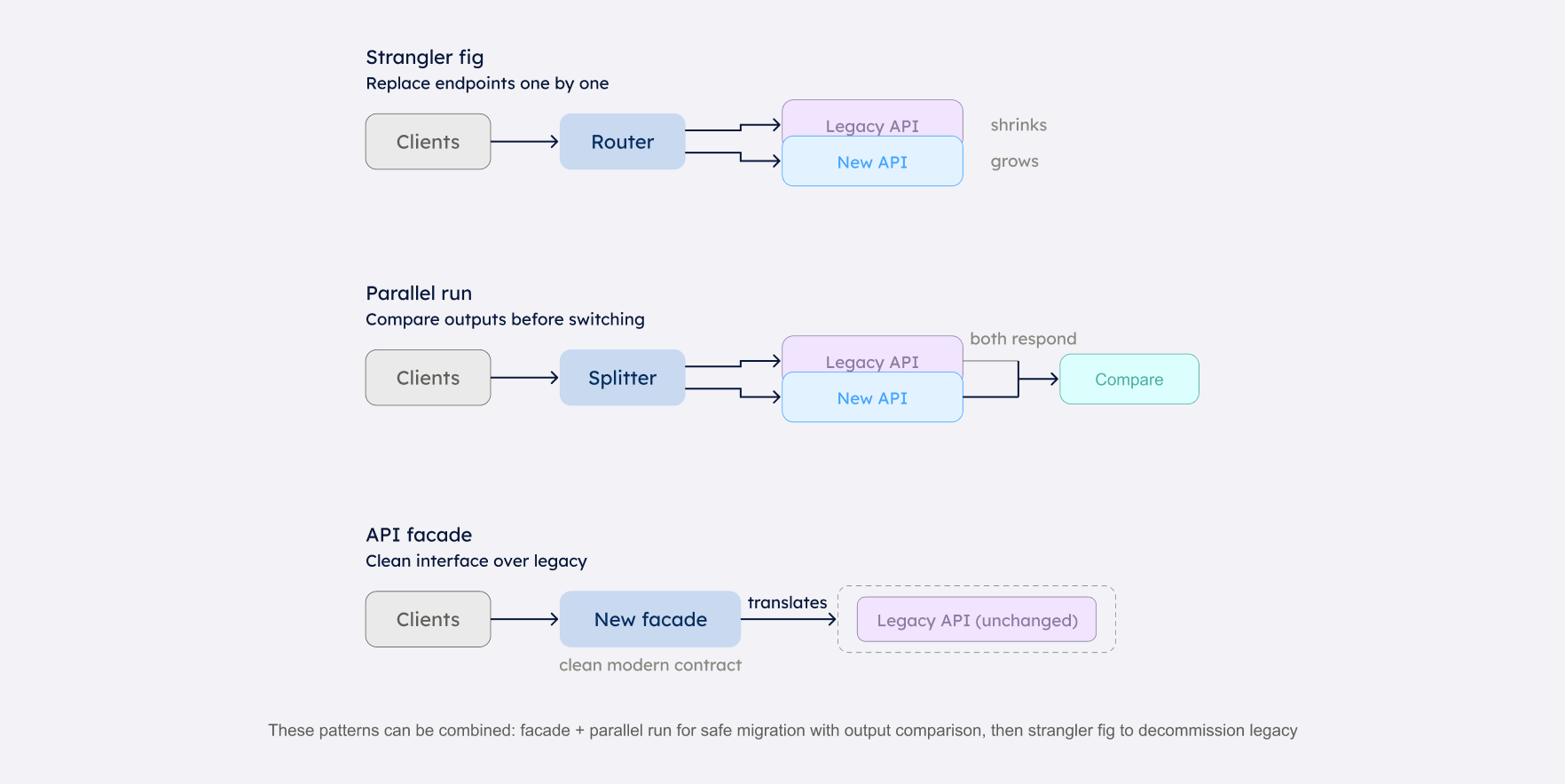
The Strangler Fig pattern lets you replace legacy endpoints one by one, gradually routing traffic to the new implementation. To ensure a safe transition, you can run both old and new APIs in parallel, which allows you to compare outputs and catch differences before the switch. A new API facade sits on top of the legacy system, providing consumers with a clean, modern interface while the old code continues to run underneath.
Before writing any code, also define your API contract: endpoints, request and response schemas, error formats. Share it with the frontend team, let them build against a mock server while you work on the real implementation. This way, both sides move forward without waiting on each other. And decide on versioning early, URL-based, header-based, whatever works, just don’t leave it until consumers already depend on your endpoints.
Featured API projects
RESTful API development for a SaaS-based BI solution
As a part of custom admin panel development for a SaaS business intelligence platform we developed custom internal APIs. Our team used ASP.NET Web API to build APIs that connect the system’s shared components and modules. During the development, we applied standard protocols and formats – HTTP, WebSockets, SSL, JSON, and XML. SoftTeco’s software engineers applied clean architecture with CQRS to make APIs more maintainable, scalable, and flexible under high-load scenarios.
Google Maps API integration for a vet appointment booking platform
SoftTeco implemented the core API integration for a cross-platform mobile app for vet booking. This integration allows veterinarians to plan and navigate their daily routes for home appointments. Moreover, our team added a custom algorithm that analyzes visit requests and calculates the most efficient travel sequence based on waypoints coordinates. The solution optimizes travel routes, providing travel time and distance info.
API creation for wireless cellular connectivity management app
SoftTeco developed and implemented backend APIs for a communications carrier’s web application. We redesigned the application’s business logic and added a staging database to securely test migrations. The new API layer decouples application logic from direct DB access, enabling safer schema evolution and controlled, consistent data access across the system.
Industry awards we celebrate








Our engagement models
We offer flexible collaboration models so you can choose the option that best suits your project needs.
Fixed price
Select his model if your API project has clear requirements and you’re looking for a predictable cost and timeline.
Time & materials
Evolving scope requires more adaptive cooperation. Pay only for actual time and resources used, adjusting features as the project progresses.
Hybrid
Opt for a hybrid model if your project combines precision and uncertainty. Your budget remains flexible and under control.
Technologies
Programming languages/frameworks
Python, JavaScript, Java, C#, Ruby, PHP, .NET, GO
Databases
SQL (PostgreSQL, MySQL, MS SQL) and NoSQL (MongoDB, Redis)
Monitoring and analytics
Grafana, Prometheus, ELK/Seq, OpenTelemetry
Communication protocols
HTTP/HTTPS, WebSocket, gRPC, MQTT, SOAP
Authorization and authentication
OAuth 2.0, OpenID Connect (OIDC), API Keys, JWT, SAML, TLS, Basic Auth
DevOps
Docker, Kubernetes, GitHub Actions, Azure DevOps, GitLab CI
Message broker tooling
RabbitMQ, Kafka, Azure Service Bus, MassTransit




