
Visual recognition has become an integral part of modern technology, enabling machines to “see” and understand visual data. Image recognition applications span across ecommerce, agriculture, healthcare, and other industries, helping businesses to launch visual search, detect crop disease, and analyze medical images – precise and fast.

Key takeaways
- Image recognition use cases range from advertising and content moderation to medical image analysis, agriculture, product tagging and cataloging.
- The selection of image recognition technologies and methods depends on task complexity, accuracy requirements, and computational and memory resources available.
- Across industries, image recognition can reduce fraud, improve product quality, and cut document processing times, leading to fast and efficient operations.
- To develop a domain-specific image recognition solution, you need computer vision experts with deep technical expertise, analytical skills, and business understanding.
Image recognition 101
So, what exactly is image recognition? Generally, it is the ability of computers to identify and classify specific objects, places, people, text, and actions within digital images and videos. It enables software to detect, analyze, and understand visual content by comparing it to learned data, much as humans interpret what they see. And what a promising technology it is!
- According to Fortune Business Insights, the image recognition market value hit $58.56 billion in 2025, and the demand for technology is steadily growing.
- Retail and ecommerce have the largest revenue share of 28.74% in the image recognition market.
- An average error rate across datasets used in image recognition stands at 3.4%. The ImageNet dataset used by Google and Facebook has a 6% error rate.
- In manufacturing, image recognition can reduce time for defect detection by 70% and improve defect detection by almost 40%.
- In agriculture, image recognition backed by computer vision can save up to 77% of herbicide use through accurate weed detection.
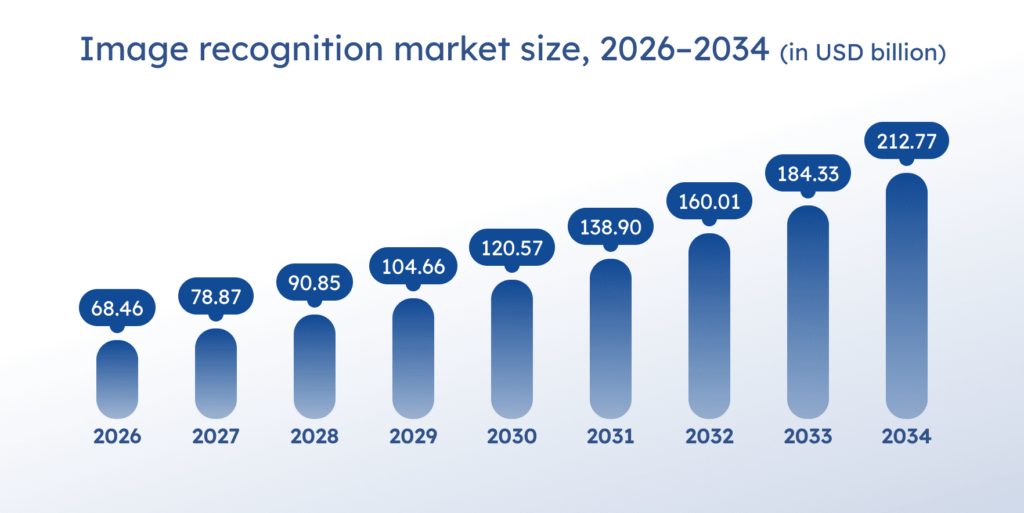
Global image recognition market size (2026–2034).
Image recognition is something we encounter practically every day, whether it’s searching by a photo on Google or unlocking a phone using a facial recognition function. But how does it all work?
How does visual recognition work?
As we mentioned earlier, image recognition is a subset of computer vision, which is a broader field of artificial intelligence. To recognize objects and differentiate a face from a vase, it utilizes machine learning and, more specifically, deep learning. Deep learning, for its part, involves neural networks — complex algorithms trained on massive datasets of labeled images. They learn to recognize patterns and extract features like edges, shapes, textures, and colors, building up a visual puzzle piece by piece.
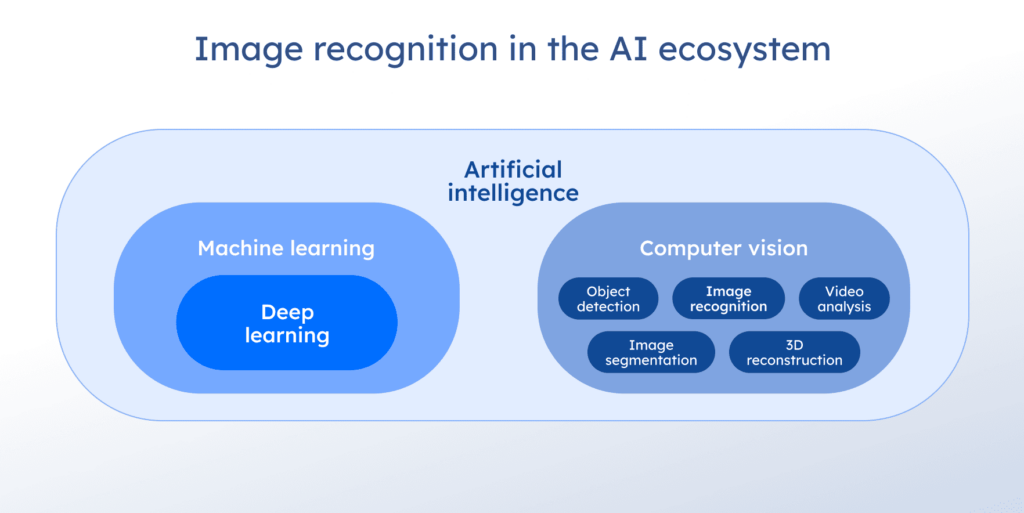
Deep learning models, particularly convolutional neural networks (CNNs), are widely used in image recognition. CNNs are designed to automatically and adaptively learn shapes, edges, and color patterns from input images. For smartphones and devices with limited computing power, a more lightweight version of the classic CNN is used, called MobileNet.
Here’s where it gets really interesting: these algorithms don’t just memorize what a cat or a tree looks like. They learn to understand the fundamental building blocks that make up those objects and scenes. For instance, a CNN might first detect simple edges and textures, then combine these into more complex shapes, and finally recognize entire objects. When these networks encounter a new image, they can break it down into its component parts and reassemble the pieces to identify what’s in the picture.
Image recognition systems still struggle with real-world conditions such as object occlusion, deformation, and bad lighting, which can reduce the accuracy and efficiency of computer vision tools.
Model training process for image recognition
Modern image recognition heavily relies on deep learning and machine learning technologies. A well-trained AI model enables correct image detection, classification, and object localization, making the outcomes accurate and reliable. Here is how the process goes.
1. Data gathering and preparation
The first step involves collecting a large and diverse dataset of images that represent the various categories or classes that the model will be trained to recognize. The quality and diversity of the dataset are critical factors that can significantly impact the performance of the trained model.
Additionally, preprocessing techniques such as normalization, resizing, and data augmentation are often applied to images to ensure uniformity and enhance the model’s robustness. You can use ready-made libraries such as OpenCV and Mahotas for noise reduction, image cropping, resizing, and color conversion during this stage.
2. Training the neural network
Once the dataset is prepared, the next step is to train the neural network using the collected images. The training data is fed into the network, which adjusts its parameters through a process known as backpropagation. During the process, the network learns to identify patterns and features within the images of the different classes. The network’s parameters are optimized iteratively through the use of optimization algorithms such as stochastic gradient descent, enabling the network to gradually improve its ability to accurately do image classification and recognition.
3. Model testing
After the neural network has been trained, it is essential to evaluate its performance on a separate set of images that it has not seen before. At this step, ML engineers can assess the model’s generalization and pattern recognition capabilities and analyze its accuracy and reliability. The experts check the model’s precision, recall, and F1-score, assess its limitations, and analyze failure cases. Later on, this information will help to adjust algorithms and make the final decision about its deployment or further refinement.
Image recognition methods
All image recognition methods can be roughly categorized into classical, pre-deep learning ones, and modern methods based on neural networks.
Classical image recognition
Classical image recognition methods rely solely on image characteristics designed and selected by humans, as well as rule-based algorithms. They usually use smaller datasets compared to modern approaches and require fewer computational resources. Today, these are used when memory is really tight or speed is needed.
- SIFT, SURF, HOG. Feature descriptors that detect key textures, shapes, and angles in images for further processing. Engineers create rules that define what features are useful.
- Support Vector Machines (SVM). Used for object classification, finding the best boundary between categories after SIFT or HOG has extracted the features from the image.
- KNN (k-nearest neighbors). Compares the image to the examples in the training dataset, finds the most similar samples, and assigns the image to the same class.
- Random forests. A classical machine learning algorithm used for object classification. Uses many decision trees to make accurate and stable predictions on image class.
- Template matching. Compares a given image with a reference image to find similarities and delivers coordinates of the matched region, similarity scope, and often puts a bounding box around the detected object.
Deep learning image recognition
Modern deep learning methods use neural networks as the core technology behind their abilities of photo recognition, object detection, and image analysis. They can learn on their own, deciding which features matter and detecting patterns (still requiring human oversight).
There are two main types of architectures for working with images:
- Convolution. Analyzes image features automatically, without human feature engineering. Good at handling changes in scale, rotation, and lighting, providing accurate outputs.
- Vision transformer. Don’t analyze the image pixel by pixel. Instead, explore patches and capture the dependencies between image regions. Deliver high accuracy for complex recognition tasks.
Moving to model training, ML engineers apply the two main approaches:
- Transfer learning. The developers use frameworks and libraries such as TensorFlow, Hugging Face Transformers, and PyTorch to fine-tune pre-trained models for new image recognition tasks.
- Training weights from scratch. Computer vision experts train the model on the specific dataset. Such an approach requires large datasets and is typically performed only by large corporations and scientists.
Trained models can fulfill different tasks when working with images:
- Object detection. Includes technologies such as PyTorch/TorchVision, Detectron2, and YOLO to identify and locate objects of different classes in a single image.
- Image classification. The model assigns a single label or a probability distribution across possible classes to a whole image. Identifies what is in the image, not where it is.
- Image segmentation. Applies a mask that labels every pixel within a class. Understands what is in the image and where the object is positioned.
Deep learning expands the abilities of LLMs. They can not only learn from large amounts of unlabelled images, but also combine them with other data types such as audio and text. It enables models to understand images and recognize complex patterns in depth.
To select the method that best solves your business problem, start by assessing the task requirements – it may be solved with basic technologies and fewer computational resources.
Prominent image recognition use cases
Today, image recognition models can be trained to identify objects and patterns that the human eye may not catch. Powered by artificial intelligence and machine learning, it helps companies automate visual tasks across industries. Here are 15 image recognition applications that continue to shape the way we interact with the world.
1. Facial recognition for security
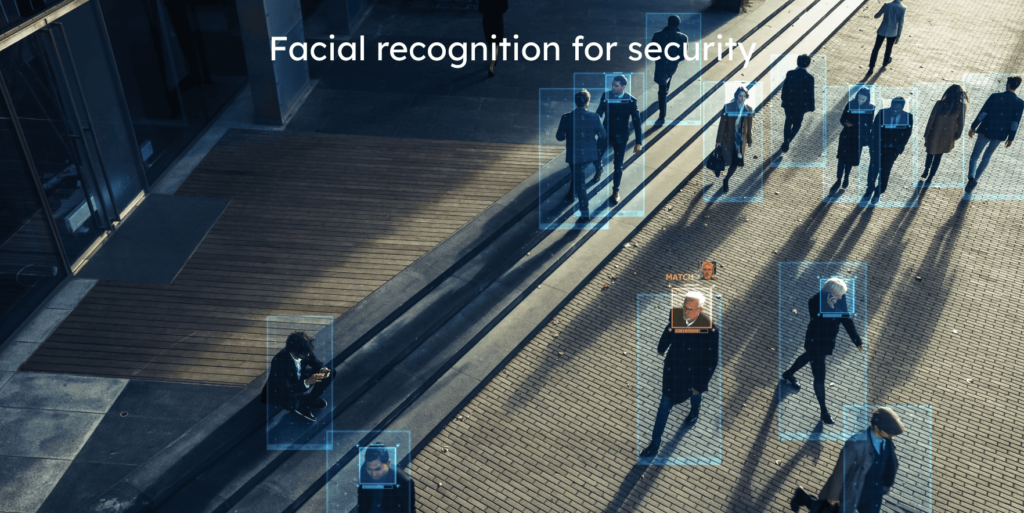
Facial recognition enables quick and accurate identification of individuals by analyzing facial features, helping in security screenings, identity verification, and access control. It is often used together with a single-shot detector (SSD) model, which can locate faces within an image or video in real time.
- Facial recognition is used at airports, offices, and secure facilities to let authorized people in. It scans faces to make sure only the right people can enter.
- Some security cameras use facial recognition to spot known troublemakers or missing persons. It helps keep public places safer.
- Some smartphones use facial recognition to unlock the device. The camera scans the owner’s face and unlocks the phone if it matches the stored face data.
- Police departments use facial recognition to find suspects in surveillance footage. It helps them solve crimes faster by identifying individuals.
In the US, the Transportation Security Administration uses facial recognition technology to verify travellers’ identity at more than 250 airports. There are two modes available: comparing the person’s live photo with the photo on the identity document, or comparing the live photo with images from the Trust Traveller Program’s system (for those who opted into the program). Facial recognition technology proved highly accurate, with false-positive rates below 0.001% and 0.3% for the corresponding modes of checks.
2. Search by image for visual shopping
Image recognition powers sophisticated image search engines that allow users to search for similar images based on content rather than keywords. This technology is widely utilized in ecommerce for visual search, where users can find products similar to an image they upload.
Companies like Pinterest, Amazon, IKEA, and eBay introduced visual search capabilities on their websites and apps to improve customer engagement and drive sales, and for a good reason – retailers who adopted visual search have 30% better conversion rates than those who didn’t.
The article from the Journal of Marketing & Social Research states that 62% of Gen Z and millennials prefer visual search over classic text-based search when looking for products online. At the same time, 45% of customers are more likely to connect with brands that offer AI search capabilities, making image recognition a technology that not only shifts the way customers engage with businesses but also brings benefits for both sides.
3. Medical image recognition for accurate diagnosis
In the healthcare sector, image recognition plays a crucial role in medical image analysis. Radiologists and doctors use this technology to interpret X-rays, MRIs, and CT scans with greater accuracy, aiding in the early detection of diseases and improving patient outcomes.
Image recognition helps doctors detect early signs of cancer in medical images like mammograms and CT scans. ML models and deep learning tools such as Detectron2 can highlight abnormal growths or tumors that might be difficult to spot for the human eye. Early detection leads to timely treatment and better chances of recovery for patients. For example, the R-CNN model combined with the Feature Pyramid Network allows doctors to detect rib fractures on chest radiographs with an accuracy of 89%.
4. Quality control in manufacturing
Manual inspection is hard, time-consuming, and susceptible to human error. In contrast, automated systems can inspect products on production lines for defects, ensuring consistency and adherence to quality standards. Applied in the automotive industry, electronics manufacturing, and pharmaceutical domain, image recognition reduces errors and improves overall product quality.
The technology can check product dimensions, detect missing components, and verify labels or barcodes before items leave the production line/are sent to the warehouse. For example, a German automaker, BMW, uses image recognition: AI helps evaluate component images to detect deviations from standards in real time during production. It helps the business to maintain high-quality standards and save workers’ time spent on repetitive tasks.
5. Target audience analysis
Image recognition technology has wide applications in the retail and ecommerce sectors. One of our projects, SeeDoo, is an excellent example of how computer vision can help businesses personalize their advertisements.
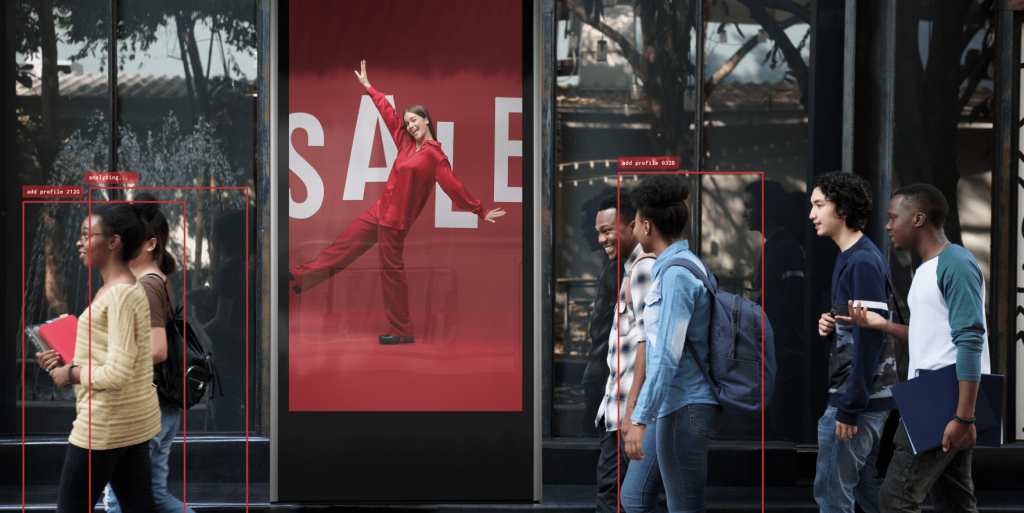
Our client sought our expertise in developing an on-premises device capable of detecting individuals and delivering relevant advertisements on DOOH displays in transportation hubs and outdoor areas. The main goal was to analyze captured images, extract key audience attributes, and present targeted advertisements for optimal effectiveness.
How we applied image recognition to tailor advertising
The device itself is a compact on-premises box with a high-resolution camera. It’s strategically positioned near DOOH displays to capture images of individuals within its coverage area. The device was equipped with NVIDIA’s Jetson mini-computer, so we converted and optimized our machine learning models into ONNX and TensorRT formats. This optimization significantly boosted data processing speed, enabling real-time predictions.
We worked closely with the client’s team and developed computer vision software for the device. This software uses deep learning for object detection, tracking, and classification. Photo recognition technology accurately analyzes visual data, identifies specific attributes, and displays targeted ads on nearby screens based on requirements. This method tailors ads directly to the audience, making them more impactful and effective.

6. Content filtration and monitoring
Social media platforms and online content providers utilize image recognition for content moderation. It helps filter out inappropriate or harmful materials, such as explicit images or hate speech, ensuring a safer online environment for users. Businesses use machine vision and image analysis to ensure compliance with rules and brand standards.
Services like Amazon Rekognition, Microsoft Azure Computer Vision, and Google Vision AI help social media platforms to detect harmful imagery and analyze stored or streamed videos for violations. The major content platforms such as Facebook, Instagram, TikTok, and Pinterest use diverse in-house AI and ML models to detect offensive content, often combined with human review.
7. Fraud detection
The integration of AI-powered photo recognition tools can significantly streamline and bolster the process of detecting fraud. This technology analyzes images or videos to find suspicious patterns, anomalies, or discrepancies that may indicate fraudulent behavior. For example, surveillance cameras equipped with image recognition algorithms analyze customer behavior and detect unusual patterns, such as multiple returns of high-value items within a short period, signaling potential fraud.
AI image identification is also useful in identifying deepfakes. Namely, it can distinguish unusual and inconsistent facial features, unnatural movements, and other indicators of a deepfake to prevent identity theft or other malicious actions.
Expanding the potential of computer vision
Nowadays, the problem of computer vision remains one of the most popular among businesses. It’s not a surprise because visual detection can benefit many industries due to its high automation capabilities. Five years ago, the task was to reach people’s level of visual perception (to save time and money); now the task is to make it even better (to avoid people’s perception biases). Last year was also important for this branch of AI because LLMs can contribute not only to text but also to image processing. This is a huge step forward in the development of AI, impacting many industries as well.

8. Autonomous vehicle navigation
Self-driving cars and their ability to see, analyze, and respond to a changing environment are among the most impressive image recognition applications in the automotive industry. Real-time object detection systems like YOLO (You Only Look Once) help autonomous cars with other vehicle detection, traffic sign recognition, pedestrian and lane tracking, raising overall situational awareness during the ride.
Waymo, an autonomous ride-hailing service provider, uses high-resolution automotive cameras, radars, and light detection and ranging technology to make its passengers’ rides safe and comfortable. The data from sensors is processed and analyzed by AI models, enabling smart cars to detect obstacles and precisely estimate traffic situations during different weather and lighting conditions.
9. Personalized manufacturing
Image recognition technology can significantly improve the quality of products in specialized manufacturing industries. Let’s consider another interesting project by SoftTeco – Golf Club.
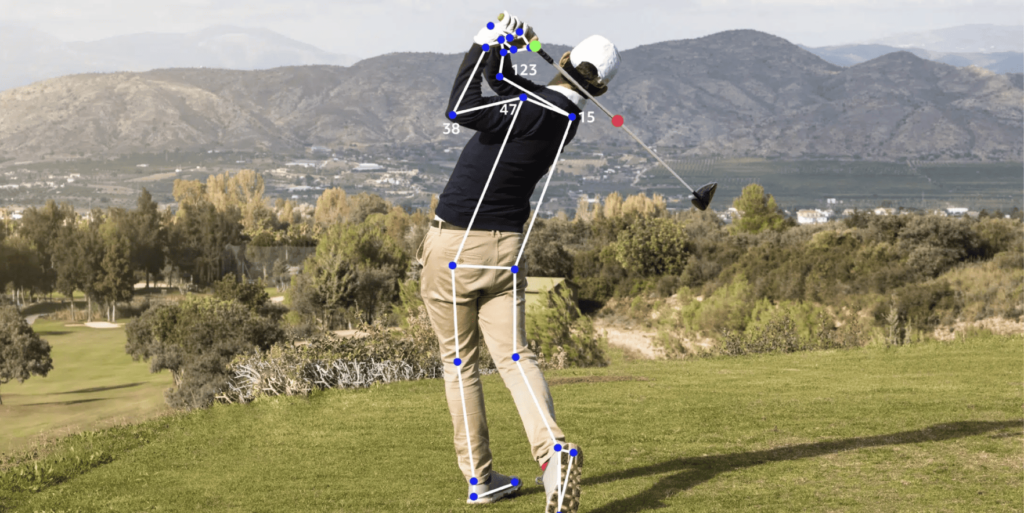
Our client, a custom golf club manufacturer, approached us with an innovative idea: to develop an AI-based solution that will analyze players’ positions and strokes to help them design personalized golf clubs. We developed an AI-powered solution that can see and measure how golfers hold their clubs and how they swing them. It then uses this information to figure out the technical specifications needed to manufacture customized clubs.
This program works by taking pictures either from a phone or a special camera. With these pictures, the client can make clubs that match how hard players hit the ball, how they stand, and how they swing.
To make this work, we developed two smart computer models. One model detects where the player’s hand and club are. The other model uses image segmentation to distinguish the club from the surroundings. Together, these models get all the info needed to make a custom golf club that fits just right. This technology helps the program see the club clearly, even among other things in the picture, and know the difference between the player’s arm and the club.
10. Automated document processing
Automated document processing captures, validates, and processes information from scanned and digital documents with the help of image recognition, optical character recognition (OCR), and convolutional neural networks. Its application fields vary from invoice processing to medical records digitalization, converting unstructured documents into structured data.
A great real-world illustration of efficient document processing is Omega Healthcare. By introducing an AI tool for document processing, the organization managed to cut employees’ time spent on documentation by 40%, reduce document turnaround time by 50%, and reach a prominent accuracy of 95.5%.
11. Crop monitoring
Agriculture also offers several remarkable image recognition examples. SoftTeco used the technology for building an AI-based solution for banana leaf disease detection – BananaAI.
Our development team has successfully created and fine-tuned an AI-powered classification model for monitoring and overseeing the growth of banana trees in greenhouses and plantations. The main goal was to streamline the tasks of agronomists by automating routine processes and promptly identifying any potential issues.
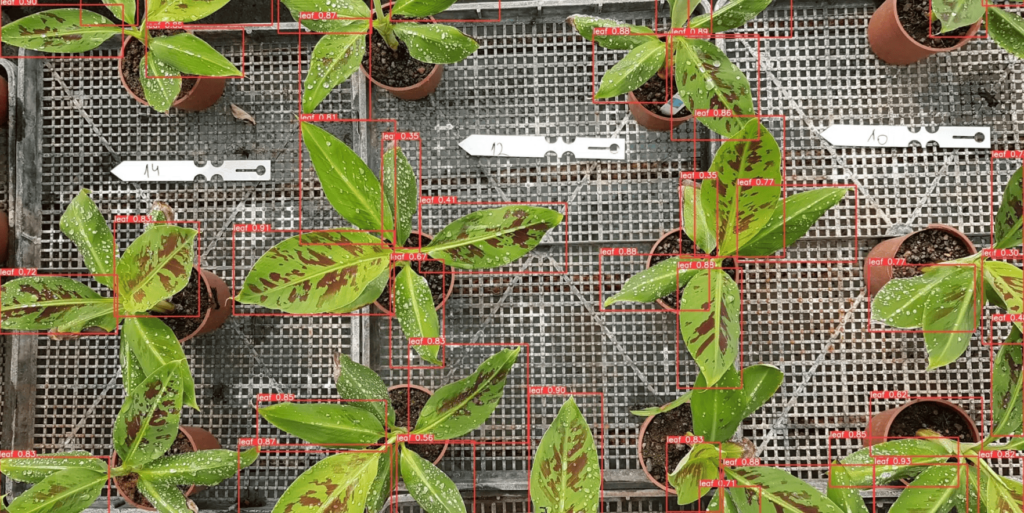
We created a computer vision system capable of autonomously examining banana seedling leaves and identifying signs of damage. To achieve this, SoftTeco utilized advanced object detection techniques and deep learning algorithms to train a model specifically designed for recognizing damaged banana leaves. This module diligently inspects real-time photos of banana tree leaves in the greenhouse, categorizing any observed leaf damage.
Computer vision’s real impact on agriculture
Throughout the project, we managed data collection, processing, and annotation, crafting custom datasets tailored for training and testing our model. As a result, the model can now identify and distinguish various types of damage, generating a comprehensive report that provides a detailed assessment of the plant’s overall condition based on the analyzed images.
12. Smart packaging
In manufacturing, pharmaceuticals, ecommerce, and other industries, image recognition is widely used not only for visual quality control and inventory tracking, but also for packaging checks. With the help of computer vision, manufacturers can detect misaligned labels, broken seals, crushed cartons, and deformed boxes, lowering damage rates, reducing wrapper and filler waste, and helping achieve environmental targets.
One of the world’s largest retailers, Amazon, uses AI models, including deep learning, natural language processing, and computer vision, to define the right packaging type and durability. For example, glasses and blankets require different layers of packaging. The innovation helps the company to reduce waste and meet sustainability goals. Machine learning models also help determine the optimal packaging for orders with several items, reducing space inside the boxes.
13. Damage assessment for insurance companies
In modern insurance software development, image recognition has become a widely used technology for accelerating claim resolution and detecting fraud. Insurance apps allow customers to assess vehicle or property damage in real time by simply uploading photos, where an AI model preprocesses them, detects, and classifies the damage.
Solutions like Tractable and Inspektlabs emerged in the early 2020s for insurance companies. A UK-based insurance company, Ageas, was among the first adopters of AI technology in the country for end-to-end car damage assessments. Another UK company, Aviva, reduced customer complaints by 65% by introducing automated claim processing.
14. Intelligent home management
Machine vision has proved helpful in everyday life. Combined with devices such as robotic vacuum cleaners, smart mirrors, and baby monitors, image recognition and AI models help smart appliances to navigate rooms, advise on exercises and posture, and detect baby movements and facial expressions.

In a recent project, SoftTeco created a mobile app that connects with a baby monitoring device and sends caregivers notifications anytime the baby starts crying. For accurate face recognition, the user should first upload a photo of the baby. The system will then be ready for audio and video monitoring. The Evoz app provides a live video stream or camera-generated images refreshed every 30 seconds, ensuring the baby is healthy and comfortable.
15. Augmented visual assistance
In 2013, Google Glass was pioneered as a consumer and later an enterprise device, offering on-the-go audio and video recording, voice assistance, and hands-free messaging. Its successors – Ray-Ban Meta Smart Glasses and Microsoft HoloLens 2 continue to assist people in personal activities and work environments.
Image recognition is the foundation of more complex smart glasses capabilities. For example, world anchoring, a technology used in AR, allows virtual objects to remain fixed in a real-world environment by identifying and tracking their features. First, machine vision detects key features of the surroundings, like surfaces and objects. Then, they are analyzed by an AR engine, which identifies anchor points. Finally, it places virtual objects relative to them and adjusts the image as the user moves.
For example, Boeing introduced smart glasses and specialized AR software to their wiring harness assembly process, cutting production time by 25%. Their competitor, Airbus, also followed suit, resulting in significant time savings in flight-test equipment installation.
Summing up
AI picture recognition offers industry innovation across the industries, from intelligent visual assistance in manufacturing to automated fracture recognition on X-ray scans. More companies are adopting image recognition in everyday operations – its applications make operations faster, safer, and the outcomes more precise. The technology also influences everyday experiences, making people’s lives more convenient with self-driving cars and smart image searches.
If you have ideas to explore, you probably need a skilled partner who can help analyze, plan, and fulfill what you’re up to. SoftTeco’s team excels in AI and ML and is ready to tackle any challenge, so feel free to reach out for a free consultation.






Comments