
One of the most popular questions in 2026 is “how much does it cost to build an AI agent?” The reason is obvious. Agentic AI is booming today because these systems can autonomously perform actions, solve complex problems, and automate a wide range of operations. Agents become a key driver of companies’ future growth.
The cost of developing an autonomous AI agent can range widely from $20,000 for simple agents to $500,000+ for complex ones and depends on a combination of technical, operational, and business requirements. This guide provides a structured breakdown of AI agent design pricing in 2026, based on system types, AI models, infrastructure, integrations, security requirements and other vital factors that determine the final cost.
![AI Agent Development Cost in 2026: Full Budget Estimates [+Team Calculator]](https://softteco.com/wp-content/uploads/2026/03/AI-Agent-Development-Cost-in-2026Will-AI-replace-software-engineers_big-1-1024x513.png)
AI agent: statistics
AI agents are ubiquitous today, and their popularity is only growing. Their widespread adoption has been driven by increased demand for automation, advances in NLP, and personalized customer interactions. Before we move to cost estimation, let’s look at the current state of the technology.
According to Grand View Research, the global AI agent market is projected to reach $182.97 billion by 2033, growing at an annual growth rate of 49.6% from 2026 to 2033.
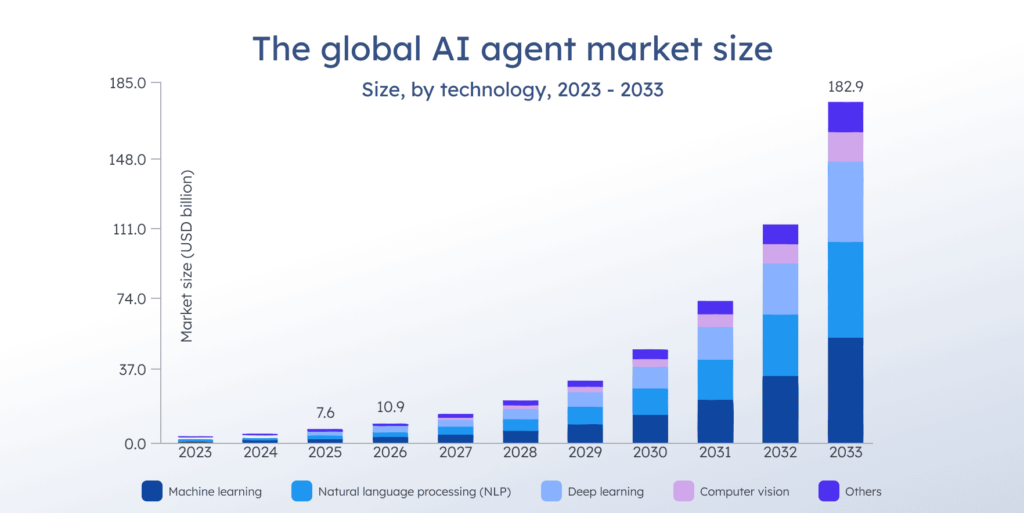
The global AI agent market size. Source
According to Gartner, 33% of enterprise software applications will include agentic AI by 2028, up from less than 1% in 2024. At least 15% of everyday work decisions will be made autonomously using agent-based AI by 2028.
According to MCKinsey, 23% of respondents report that their organizations are using an agent-based AI system at some level within their enterprise, and another 39% say they have begun experimenting with AI agents.
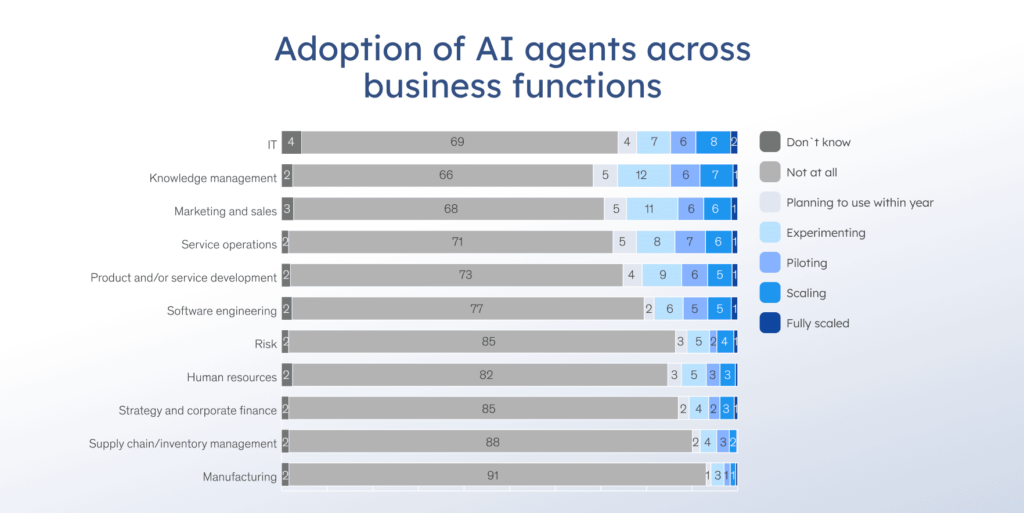
Adoption of AI agents across business functions. Source
According to PwC survey, 73% of respondents believe that their use of AI agents will provide them with a significant competitive advantage in the next 12 months, and 75% are confident in their company’s strategy for implementing AI agents.
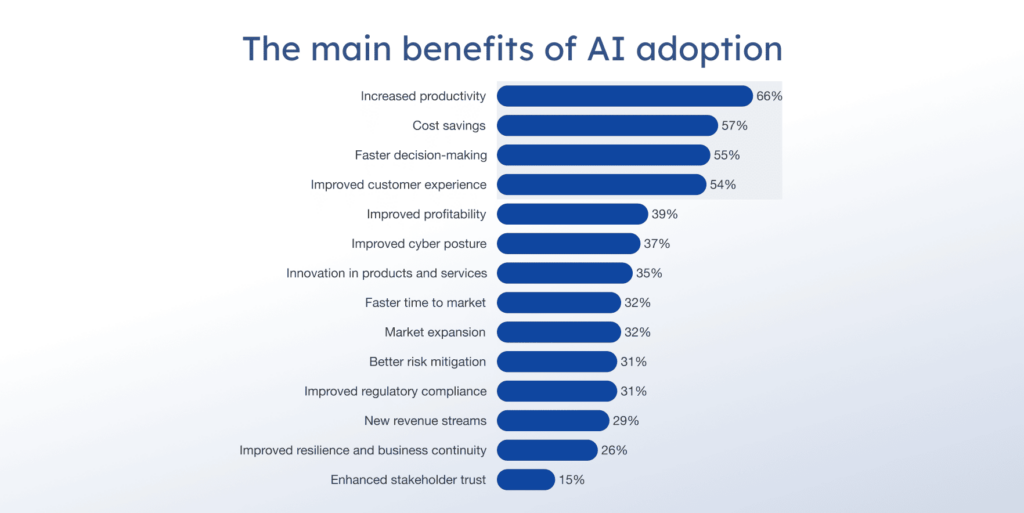
The main benefits of AI adoption. Source
Respondents expressed the highest levels of AI agent trust in areas such as data analysis 38%, productivity improvement 35%, and daily collaboration with team members 31%.
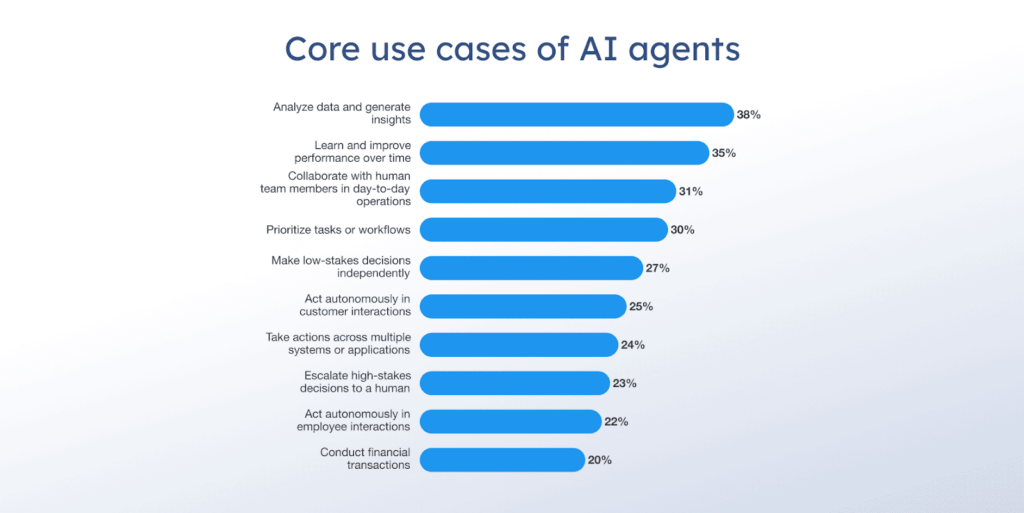
Core use cases of AI agents. Source
35% of companies implementing AI agents say they are doing so across the board, while another 17% have fully integrated them into nearly all workflows and functions.
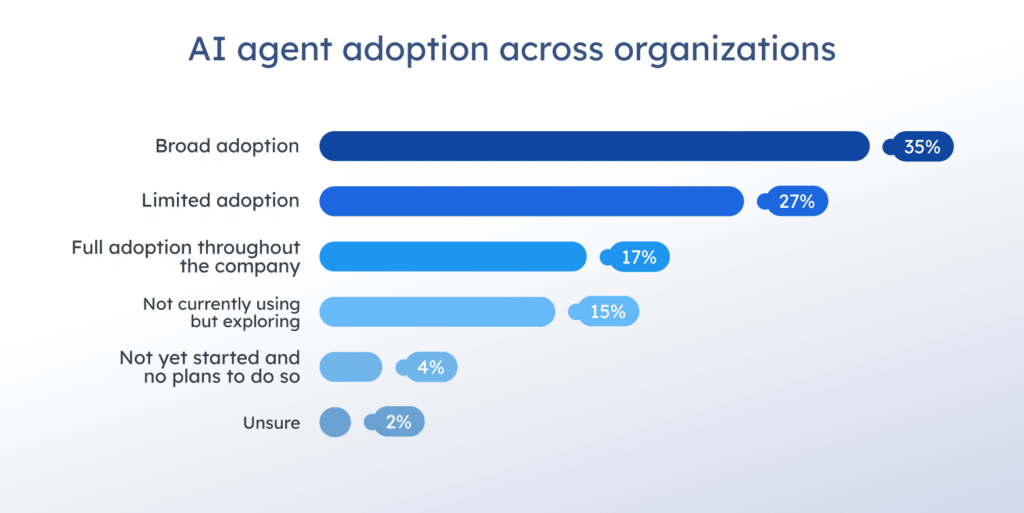
AI agent adoption across organizations. Source
AI agent types and their costs
The cost of developing agents can be significantly lower if you already have the necessary infrastructure for data processing and APIs. The greatest increase in costs occurs when the client lacks infrastructure but requires the agent to perform complex security-related operations, such as authentication or database writing. Such projects require a significant amount of additional work.
Costs also increase if the solution needs to be deployed on-premises, including LLM hosting. Infrastructure and deployment requirements can affect the price just as much as the complexity of the agent itself. We’ll talk about them in-depth below.
Beyond this, the cost and development time are also influenced by the chosen AI agent type. They are classified according to their level of intelligence, decision-making processes, and methods of interacting with the environment to achieve results.
Rule-based/simple reflex agents
Simple reflex agents operate according to predefined rules and available data to respond to environmental conditions. These rules are typically established based on expert knowledge or domain-specific requirements. Simple reflex agents cannot take past experiences or future consequences into account when deciding on an action.
Principle: Check X – do Y – action
Use cases: FAQ bots, step-by-step instructions, simple automation.
Pros:
- Effective in predictable environments where the rules are well-defined.
- Provide total transparency, making it easy to understand and debug their operations.
- Consume fewer system resources, and are more cost-effective.
Cons:
- Not effective in dynamic or complex scenarios that require memory, learning, or NLP operations.
- Can make the same mistakes repeatedly if predefined rules are insufficient to handle new situations.
- As complexity increases, the number of rules grows, making systems difficult to manage and maintain.
The average price for developing a rule-based/simple reflex AI agent ranges from $10,000 to over $30,000. Additional expenses emerge for hosting, integrations, and ongoing support of the solution.
Contextual/model-based reflex agents
A model-based reflex agent is a more advanced version of a simple reflexive agent. While it still relies on predefined rules, it combines current views of the world with past events to make decisions or act accordingly. These agents also have a memory and the ability to understand the context.
Principle: current input – stored state (from past) – action
Use cases: climate control systems, financial fraud detection, self-driving cars, tracking and energy management systems.
Pros:
- Can remember and learn, unlike simple reflex agents.
- In dynamic environments, these agents outperform others by predicting and adapting to changes.
- Memory helps avoid repeating the same incorrect actions.
Cons:
- Lack the sophisticated reasoning or learning capabilities to solve complex problems.
- Maintaining and updating a model can slow down decision-making in time-sensitive situations.
- May make incorrect decisions due to poor data or faulty assumptions.
The average price to build a model-based reflex AI agent ranges from $40,000 to $80,000+. Extra costs include a cloud solution ($20–$5,000+/month), a data storage solution ($10–$3,000+/month), and regular maintenance.
Goal-based agents
Goal-based agents take a proactive approach to problem-solving and decision-making. They use planning and reasoning to evaluate various possible actions and select the action most likely to achieve a predefined goal.
Principle: goal – evaluation of possible actions – selected action
Use cases: traffic and resource management, robotics, diagnostic assistance, treatment planning, and patient monitoring.
Pros:
- Particularly useful in complex environments where flexibility and adaptability are essential.
- Can think beyond the present moment, use search algorithms, predict future scenarios, and adapt to changing conditions.
- Can evaluate many alternatives before making a decision.
Cons:
- Require substantial computational resources for decision-making in complex environments.
- More complex to develop and implement than simple agents.
- Agents’ performance may decrease in highly uncertain or rapidly changing environments.
The average price for developing a goal-based agent ranges from approximately $40,000 to $150,000+, and depends mainly on the level of autonomy, maintenance, and complexity.
Utility-based agents
Utility-based agents use a scoring system (utility functions) to set priorities and make decisions, considering a range of possible outcomes. Unlike agents that follow pre-defined rules or have a goal, such agents evaluate multiple factors (safety, efficiency) and choose the action that maximizes their overall benefits.
Principle: evaluate possible outcomes – assign utility – choose action with the highest utility – action
Use cases: home energy systems, robotics, personalized medicine, self-driving cars, logistics and supply chain automation, recommendation and pricing systems.
Pros:
- Used in dynamic, complex environments and maintain performance even in the face of uncertain outcomes.
- Adapt their decisions to changing priorities.
- Make intelligent decisions when comparing similarly good options.
Cons:
- Extensive calculations are required to evaluate all possible outcomes.
- Poor ranking criteria can lead to flawed decisions.
- Decision-making takes longer because it requires analyzing multiple options.
The average price for developing utility-based agents typically ranges from $80,000 to $200,000, as they require advanced mathematical modeling and complex integration.
Learning agents
Learning agents constantly interact with environmental feedback to adjust their actions and improve decision-making through experience. They combine multiple learning approaches: reinforcement learning, supervised learning, and unsupervised learning.
Principle: action – feedback – correction – improvement
Use cases: autonomous robots, personalized recommendation systems, financial trading, and customer service chatbots.
Pros:
- Adapt to environmental changes autonomously, without the need for manual programming.
- Effectively cope with dynamic situations, such as changing customer preferences.
- Are self-configuring without the need for constant updates.
Cons:
- Poor-quality training data can lead to erroneous decisions that only worsen over time.
- Require careful monitoring to prevent the development of undesirable patterns of behavior or bias.
- The initial training period requires significant resources before optimal performance can be achieved.
The average cost to create learning agents starts at $100,000 and can reach $300,000+ for complex solutions with advanced ML capabilities.
Retrieval-augmented generation (RAG) agents
A retrieval-augmented generation agent is an artificial intelligence system that extracts relevant information from external data sources to combine them with generative capabilities and provide more accurate responses. It enables models to be more accurate in domain-specific contexts without the need for fine-tuning.
A RAG agent is one of the most popular solutions. Clients often have their own databases and want the LLM to use them. This is precisely when a RAG agent becomes indispensable.
Principle: query – information retrieval – context augmentation – response generation
Use cases: real-time question answering, automated customer support, data management, and document analysis.
Pros:
- Can pull data from external sources in real time, ensuring they always have access to up-to-date information.
- Reduces the need for large, highly tuned models by combining search and generation.
- Improves response accuracy by better understanding context and reducing hallucinations.
Cons:
- The answer depends on the quality of the data received.
- Slower response time due to retrieving data from large or external sources.
- Storing large knowledge bases requires significant storage, memory, and computational resources.
RAG agents typically cost $100,000 to $300,000 due to the difficulty of integrating search and generation components.
Multi-agent systems (MAS)
A multi-agent system consists of many AI agents that work together within a shared, unpredictable environment to complete a task on behalf of the user or system.
Each agent has a role and specific capabilities: the first can plan, the second can retrieve data, and the third can act.
Principle: perception – reasoning and decision-making – action – interaction – orchestration
Use cases: supply chain management, customer services, software development, traffic and transportation management, smart grids and energy systems, swarm robotics.
Pros:
- They are capable of solving complex problems through coordinated efforts among numerous agents.
- You can add new agents to an MAS without compromising system performance.
- MAS can adjust its algorithms in response to new information or unforeseen issues, all without requiring constant human intervention.
Cons:
- Difficult to manage, especially as more agents are added.
- Agents’ interactions can produce unexpected results, and it can be difficult to test for every outcome.
- It is complicated to create and use such systems as they require careful planning and powerful infrastructure.
The cost of creating a multi-gent system can range from $200,000 to $500,000+ and depends on complexity, the number of agents, computing resources, licensing fees, and more.
Hierarchical agents
Hierarchical agents are structured into a multi-level system, where high-level agents coordinate the actions of mid-level and low-level ones. Such systems break complex tasks into small, manageable tasks to enable more organized control, decision-making, and scalable execution.
Principle: high-level planning – task distribution among agents – communication and coordination – action
Use cases: autonomous systems, robotics in manufacturing and logistics,game development.
Pros:
- Automatically assigns tasks to the most suitable AI agents.
- Work well in large systems where coordination is critical.
- Separate strategic planning from tactical execution, enabling targeted optimization at each level.
Cons:
- Training a hierarchy is more complex than training a single model.
- If a top-level agent fails, it can disrupt the entire system.
- Low-level agents may cope poorly with unexpected situations without proper design and planning.
Developing hierarchical agents costs approximately $100,000–400,000+ due to the sophisticated system design, integration with enterprise systems, and high requirements for scalability, security, and coordination between agents.
AI agent development cost breakdown
As with AI app development cost, creating agents depends on many factors and does not have a fixed price. Typically, the total cost is calculated based on AI development stages, each with its own specific characteristics and prices.
Research and planning ($5,000–$15,000)
Before coding AI agents and training models, the first and most important stage is research with planning. The average cost of the research and planning stage ranges from $5,000 to $15,000. This phase will help you define the purpose of the AI agent, its tasks, and its functionality, laying the foundation for the system. The following questions may be helpful:
- What are the capabilities of the AI agent: will it perform analysis, interact with customers, or sort files?
- What are the expected outcomes: process automation, improved customer service, or operational efficiency?
- What data is needed, and how will it be obtained and used?
- Will the agent require/allow human intervention?
- What are the regulatory requirements?
To make this process as easier and as accurate as possible, you can look for artificial intelligence consulting services. With it, you will be able to save up to 30% of your total budget, which is a significant risk if omitted. The result of this stage is the documentation outlining the AI agent’s basic requirements, architecture, data sources, and various metrics.
Data collection and preparation ($10,000–$70,000+)
The cost of data collection and preparation stage can fluctuate between $10,000 and $70,000+, and depends on the volume of data, its quality, and the complexity of pre-processing and labeling.
During the data collection and preparation stage, companies first need to determine which data types (structured, unstructured, real-time) and from which sources (internal, external) these datasets will be obtained. If the client already has the data, ML experts need to analyze it, determine how to extract the necessary entries for the agent, and organize it properly. They need to clean, label, and preprocess the data to find errors, verify data consistency, and fix missing values. This is vital for further model training on the relevant, up-to-date, and quality data, which directly impacts the accuracy of AI decision-making.
Training and fine-tuning such agents requires large datasets. Poor data quality can increase the costs of preprocessing and cleaning. At the same time, structured data offers greater efficiency in model training. The more data you need to collect, prepare, and process, the more development time and resources the project will require. After data preparation, you may need to incur additional costs to ensure compliance with relevant standards, such as GDPR and HIPAA.
ML model setup and training ($15,000–$100,000+)
The cost of the ML model setup and training phase can be anything between $15,000–$100,000+ and depends on the complexity of the tasks, the amount and quality of data, required accuracy, compute resources, and the level of ML expertise. Let’s consider it in-depth.
First of all, businesses decide whether to train the model from scratch or refine an already trained model for specific tasks. In reality, the majority of companies often use pre-trained large language models (LLMs). Fine-tuning of such systems involves feeding the model domain-specific examples and adjusting its parameters to improve performance according to the client’s needs. This approach reduces time and costs compared to training the model from scratch, while ensuring high accuracy for the target tasks.
Model development ($20,000–$200,000+)
The cost of the model development stage ranges from $20,000 to $200,000+ and depends on the architecture you picked previously. During this stage, ML experts select a suitable LLM (based on quality, price, speed, memory, and processing requirements, etc.) depending on the client’s needs, budget, and compliance constraints. Then, tech experts choose a deployment method: either use APIs from third-party providers (such as OpenAI) or deploy open-source models.
Experts also select deployment type: on-premises or in the cloud. If necessary, specialists fine-tune the model to the client’s data, although many projects instead rely on pre-trained models with optimized embeddings. They select and deploy a vector database or other embedding storage solution to support efficient search.
Specialists configure the data search to ensure fast, accurate information retrieval. They set up an agent pipeline using various frameworks (LangGraph, n8n, Langflow) and add business logic and tools to the pipeline, including decision rules, request routing, and model monitoring. Often, the flow includes HITL (human-in-the-loop), so there are certain stages where a person can also intervene in the pipeline’s operation.
Integration and workflow orchestration ($20,000–$50,000+)
The cost of the integration and workflow orchestration stage can range from $20,000 to $50,000+ and depends on the number of systems, the complexity of tasks, the level of automation, and the chosen orchestration method.
To get the most out of AI, you need to integrate it with the necessary systems and services. It might be ecommerce platforms, databases, CRM, marketing, or enterprise tools. Integration enables AI agents to assess data and automate processes across multiple systems. Along with that, keep in mind that each new connection increases AI development and testing time. There are different ways to build integrations:
- Native builds. Developers create and maintain integrations themselves. It can be incredibly complex and resource-intensive.
- Embedded iPaaS solution. Enables developers to create integrations and automations via a workflow builder interface. It can speed up integration by providing ready-made connectors and automation templates.
- Model context protocol (MCP). Allows AI agents to interact with client data using tools and specific functions provided by the MCP server. This is the preferred option because AI systems can act autonomously, choosing which tools to use based on user input.
- Unified API platform. Allows programmers to add as many integrations as possible across different categories through a single integration. It lets anyone quickly and easily support all integrations for an AI agent.
The choice of integration option depends on the complexity of the AI system, the level of automation required, and scalability needs.
As your business grows, you may need more than one AI agent to handle complex tasks. Workflow orchestration helps you achieve efficient, flat performance for the simultaneous operations of multiple AI agents. There are various types of AI agent orchestration to choose from:
- Centralized orchestration. One AI orchestrator agent manages all other agents, assigns tasks, and makes the last decisions.
- Decentralized orchestration. There is no single controlling agent, as everyone communicates directly with each other and makes independent decisions.
- Hierarchical orchestration: AI agents are arranged in layers, each performing a distinct task.
- Federated orchestration. Collaboration between independent AI agents or individual organizations allows them to work together without fully sharing data or refusing to control their individual systems.
Regardless of type, orchestrating AI agents brings organizations benefits, such as improved agent coordination, greater scalability, faster, more reliable decision-making, and higher fault tolerance.
Testing and validation ($5,000–$50,000+)
The cost of testing and validation of an AI agent phase ranges significantly from $5,000 to $50,000+ and depends, first of all, on the complexity of the solution, the diversity of scenarios, the types of tests, the regularity, and the long-term support.
Unlike LLM models, agents integrate with tools, retain memory of interactions, schedule tasks, and execute them autonomously. Agents are more complex, and errors can occur in multi-step scenarios. This all makes traditional software testing ineffective. Agent testing goes beyond a code review, as you must verify the AI’s behavior, accuracy, and fairness.
Validating agents requires multi-layered testing that involves resources and time, directly impacting the cost of system development. Skipping such testing is a big risk. But attention to it helps identify errors early on and minimize the cost of fixing bugs in production. You can start by validating individual components before considering complete execution flows. Some of the main types of AI agent tests include:
- Unit tests verify individual elements of an AI agent, such as prompt patterns, logic, and decision functions.
- Integration tests verify agent interactions with tools, ensure the system passes the correct API parameters, handles errors, and analyzes responses.
- Trajectory estimates assess an agent’s multistep reasoning and problem partitioning logic.
- End-to-end tests simulate real workflows and measure success rates, response times, and failure types.
- Regression tests re-run established scenarios to ensure that updates to a system don’t break existing functionality.
- Security tests check that agents do not perform unsafe operations or generate harmful outputs.
- Human-in-the-loop (HITL) evaluation involves interaction between QA engineers and the system to assess aspects such as conversational flow, response usefulness, and ethical consistency in an agent’s choices.
Deployment and monitoring ($10,000–$30,000)
When you build an AI agent that works well in development, the next step is to get it to work reliably in production as well. The cost of the deployment and monitoring stage of an AI agent can range from $10,000 to $30,000. It depends upon system scalability, memory requirements, task complexity, budget, and team experience.
The first step is to decide how the agent will operate. The first approach is stateless, where each request is made anew, with no memory of previous events (document analysis). The second is stateful, in which the agent remembers past interactions (e.g., chatbots and assistants). The third is asynchronous (event-driven), when the agent responds to events and performs long-running tasks in the background.
The third step is to prepare the agent infrastructure,which consists of five layers: computing, data storage, communication, observability, and security. The next step is to set how agents will organize in production, depending on task complexity and volume requirements. It might be a single-agent deployment (to handle one specific task), a multi-agent distributed system (that divides tasks across other agents), or an agent pool with load balancing (to handle high-volume scenarios).
After that, you need to containerize the agent, deploy it in the cloud, and set up CI/CD to automate testing and deployment. The final step is implementing system monitoring, which ensures reliable and secure agent operation in production. This will help you prevent bottlenecks and unexpected costs.
Maintenance and scaling ($5,000–$50,000+)
Once an AI agent is launched, the work doesn’t stop. The cost of maintaining and scaling an AI agent can range from $5,000 to over $50,000 annually and depends on system complexity, data volume, infrastructure requirements, security, and compliance needs.
This stage is crucial as it gives you an understanding of whether your agent can perform as expected and adapt to changing needs over time. Maintenance includes fixing errors, bugs, and unusual behaviour, as well as retraining models, adding new features, performing performance optimization, and ensuring compliance with privacy standards and regulatory requirements.
As your agent increases the number of users or tasks, scaling becomes critical to keep its performance and reliability. You can consider vertical scaling (adding additional resources to the existing infrastructure), horizontal scaling (adding more servers to distribute the workload), and load balancing (evenly distributing the workload across multiple servers).
How much does custom AI agent development cost?
As we already said, the cost of building an intelligent, custom AI agent can range widely from $30,000 to $500,000+. To better understand price formation, let’s summarize the above-mentioned phases and cost estimates.
| Phase | Complexity | Cost |
|---|---|---|
| Research and planning | Low | $5,000–$15,000 |
| Data collection and preparation | Low | $10,000–$70,000+ |
| ML model setup and training | Medium | $15,000–$100,000+ |
| ML model development | High | $20,000–$200,000+ |
| Integration and workflow orchestration | High | $20,000–$50,000+ |
| Testing and validation | High | $5,000–$50,000+ |
| Deployment and monitoring | Medium | $10,000–$30,000 |
| Maintenance and scaling | High | $5,000–$50,000+ |
If you’re curious about how much an AI development team at SoftTeco might cost, use our calculator to get an immediate estimate.
Team budget calculator for custom AI agent development
Factors that influence the cost of developing an AI agent
Understanding core factors that determine the final cost of an AI agent helps organizations plan budgets more precisely and avoid throwing money away unnecessarily. Below is a chart that shows how each factor impacts the overall cost of AI project development:
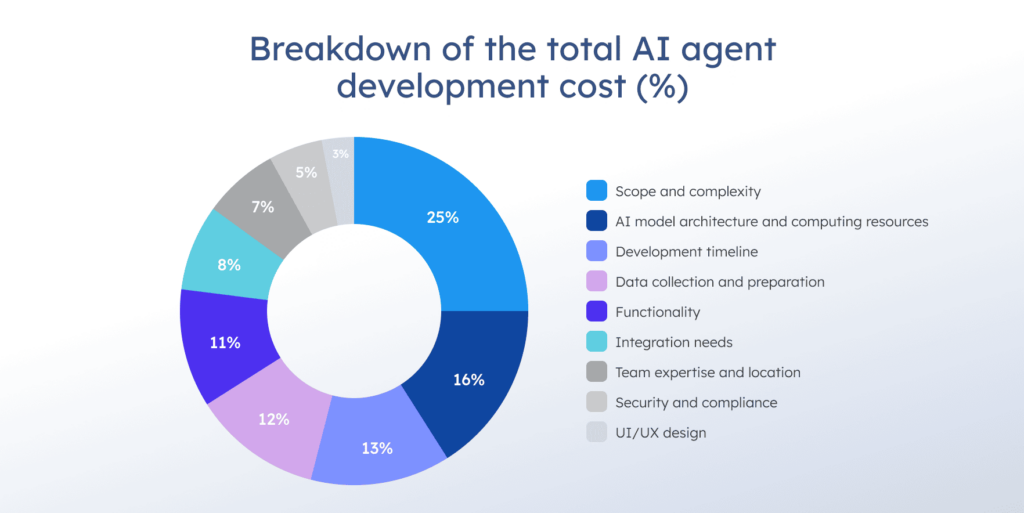
Breakdown of the total AI agent development cost (%)
Scope and complexity of an AI agent
Most importantly, the project scope is likely the primary factor driving AI agents’ development costs. More complex models require more development time, expertise, infrastructure, testing, and budget. A simple FAQ bot costs significantly less than an autonomous multi-tasking agent.
Depending on your business goal, the cost of your AI development will vary greatly depending on the type of agent you choose. We’ve discussed the main AI agent types and their costs above; let’s recap.
| Type | Cost |
|---|---|
| Rule-based / simple reflex agent | $10,000–$30,000 |
| Contextual / model-based reflex agent | $40,000–$80,000+ |
| Goal-based agent | $40,000–$150,000+ |
| Utility-based agent | $80,000–$200,000 |
| Learning agent | $100,000–$300,000+ |
| Multi-agent system | $200,000–$500,000+ |
| Retrieval-augmented generation (RAG) agent | $100,000–$300,000 |
| Hierarchical agent | $100,000–$400,000+ |
Industry and use cases
The cost of AI agents depends on the industry and use case as well. For example, in highly regulated sectors such as healthcare and banking, strict requirements for AI explainability and security complicate the process, extend development times, and increase costs.
| Model | Development costs | Monthly costs |
|---|---|---|
| Sales intelligence agent | $60,000–$120,000 | $3,000–$8,000 |
| Legal document review agent | $100,000–$200,000 | $3,000–$10,000 |
| HR onboarding agent | $50,000–$100,000 | $2,000–$5,000 |
| Customer support agent | $40,000–$120,000 | $2,500–$5,000 |
| AI-powered virtual assistant | $40,000–$100,000 | $1,500–$4,500 |
| Robotic agent | $120,000–$350,000+ | $4,000–$8,000 |
| Sales agent | $70,000–$180,000 | $3,000–$6,000 |
| Marketing agent | $60,000–$150,000 | $2,500–$5,500 |
| Data analysis agent | $80,000–$180,000 | $3,000–$7,000 |
| Logistics/supply chain agent | $70,000–$150,000 | $3,000–$6,500 |
Functionalities
When building an AI agent, you may consider adding chat, or recommendations. The more features your AI system requires, the greater the computing demands, development timeline, integration, testing, and additional costs will be. So it’s recommended to prioritize core functionalities first and gradually scale them to achieve more precise fund control.
The cost of implementing features into an AI agent can range from $10,000 to $100,000+, and depends heavily on the number and complexity of functionality, as well as the required level of customization.
AI model selection
When it comes to creating an agent, you need to select the underlying AI model. Usually, businesses rely on large language models that allow agents to understand and generate human-like responses. It can be either a proprietary model provided via APIs or an open-source model that can be customized and hosted independently. The price depends on token usage, size and model capabilities and hosting approach (API or self-hosting). For example:
- GPT-5.2 (OpenAI) requires $2.50/1M tokens input, $15/1M output, and is suitable for complex agents, mathematical reasoning, and deep tool use.
- Claude 4.6 Sonnet (Anthropic) requires $3 /1M input and $15 /1M output, and is best for coding and massive codebase analysis.
- Gemini 2.5 Pro (Google) requires $1.25\1M tokens input, $10/1M output, and is appropriate for long-context research and native video/audio processing.
While open-source models are available for free, their deployment requires your own infrastructure (cloud-based or on-premises) that add cost to development. Examples of such models:
- LLaMA 3 (Meta) is the open‑source large language model that is working well for both research and commercial AI applications.
- Gemma is the lightweight open-source model built on the same research and technology as the Gemini models but they’re optimized for accessibility and ease of operation on your own hardware.
- Qwen is the strongest open-source model that is specialized for mathematics, coding, research and business needs.
API-based models typically involve ongoing usage fees based on the number of requests or tokens processed. Self-hosted models need a reliable computing infrastructure to run complicated ML workloads and specialized datasets to improve accuracy and performance. These all require additional expenses, computational resources, and expertise from ML engineers.
Infrastructure and computing resources
ML models require intensive computing resources and often the use of graphics processing units (GPUs) or specialized hardware to run efficiently. Costs associated with infrastructure typically include:
- Cloud or local services
- Software and licensing fees
- Networking
- GPU or AI accelerator resources
- Data storage solutions
- Real-time data processing frameworks
- Monitoring and logging systems
As the number of users or tasks increases, the infrastructure of an AI agent must scale to handle higher loads without sacrificing performance. This scalability requirement can impact long-term operating expenses. The cost of the agent infrastructure ranges from $10,000 to $100,000+/year and depends on system complexity and scalability needs.
Integration needs
Expect higher costs for implementing an AI agent if you want to connect to multiple external systems (CRM, ERP, enterprise databases), especially if these are legacy systems. The complexity lies in the fact that different systems have different data formats, communication protocols, and security requirements. Integrating these systems requires careful development to ensure secure communication, data synchronization, and compatibility with existing infrastructure.
For a standard API connection (1–2 systems), the cost is typically between $1,800–$4,300. For complex or legacy integration (3+ systems), you should expect $4,000–$8,500, or even more.
Memory and context management
Advanced AI agents require memory systems that allow them to maintain context across multiple interactions. This is especially important for systems designed to handle long conversations or multi-step workflows. In many cases, advanced agents use techniques such as retrieval-augmented generation (RAG) to retrieve relevant data from knowledge bases.
However, implementing persistent memory requires additional architecture, such as embedding models, retrieval mechanisms, and secure data storage. This complicates development and increases the time, cost and expense of implementation and maintenance. For example, the development and integration of RAG systems can cost anywhere from $50,000 to $500,000, depending on scale.
User interface and experience (UI/UX)
The user interface of an AI agent is no less important, as it determines how easily people can interact with the system. Users must be able to communicate with the agent through intuitive interfaces, such as chat, dashboards, or voice-based systems.
A simple text-based interface for AI is the cheapest option. A more intuitive user interface will increase AI agent deployment costs. For example, if you want to implement speech-to-text (STT) and text-to-speech (TTS), you’ll need to add voice support to the system. The cost of creating a text chat (web/application) is $1,500–$3,500, a voice chat is $2,600–$6,900, and a chat with image recognition and document understanding is $3,500–$8,600.
Security and compliance requirements
If your AI agent processes sensitive customer data, financial, or operates in a regulated industry, compliance and security entail some costs as well. To comply with security and regulatory laws (e.g., GDPR, CCPA), you may need to fork out:
- Role-based access control
- End-to-end data encryption
- Audit logging and observability
- Compliance requirements
- Consulting
- Security testing
These stages add additional engineering overhead during development, but sticking to them is necessary for developing truly reliable, industry-compliant, and trustworthy systems. By including these requirements in your budget from the start, you can avoid costly rework or regulatory issues, and, as a result, save money and time.
Development team expertise
The development team’s qualifications and location play a crucial role in determining AI agent costs. The team with an average salary typically includes:
- AI/ML engineer – $80–$180/hr (US rate)
- Data engineer – $70–$150/h (US rate)
- Backend engineer – $80–$150/h (US rate)
- DevOps/MLOps – $110–$170/h (US rate)
- QA engineer – $40–$90/h (US rate)
- UI/UX designer – $50–130/h (US rate)
- Product manager – $80–$150 (US rate)
While finding all these specialists can be time-consuming and costly, you can consider freelancers with lower hourly rates, which can reduce expenses but may come with trade-offs in quality. The best option is to consult outsourcing experts at a software development company like SoftTeco. You can find seasoned experts with secure, established processes, industry-specific expertise, and can build complex agents.
Development timeline
The cost of developing an agent and the time spent will depend on the type of a solution you wait for. Depending on your business needs, you may choose from:
- AI agent prototype/POC costs $10,000–30,000 and usually requires 4–6 weeks
- A minimum viable product (MVP) costs $20,000–$60,000 and takes 6–10 weeks
- A simple agent costs $20,000–$80,000, requires 8–12 weeks
- A complex agent costs $100,000–$500,000+, takes 12–20 weeks
AI agents are the next step in automation
AI agents are a new step in automation possibilities after two previous ones: coding itself and machine learning. In fact, it combines these two powerful instruments with human-like behaviour, able to make decisions and use different tools. There are different opinions about whether agentic LLMs are true artificial intelligence or not, but what I want to point out is that anthropologists, when they tried to distinguish what being should be considered as smart, agreed that humans became truly smart when they started using tools. Now it happens with LLMs!
LLMs with tools or agentic AI are really a step forward. Luckily for us, the development of agentic tools doesn’t take thousands of years, so we can already do very advanced things with it. Last year, most of the projects of our AI department were devoted to the development of AI agents. We have already gained great expertise in this field

How to reduce AI agent development costs: tips
A smart AI agent design strategy doesn’t mean spending less; it means allocating your budget wisely before development and without sacrificing quality. These tips help you reduce AI agent costs wherever possible.
- Use open-source frameworks. Such tools, like LangChain, AutoGen, and Haystack provide production-ready capabilities, flexibility, and help you avoid vendor lock-in that becomes expensive as your agent ecosystem scales. Plus, they have no licensing costs.
- Select pre-trained or open-source models. Developing and training an AI model from scratch is costly. Modern pre-trained language models (LLMs) allow you to fine-tune them using your own data to ensure they perform effectively in your specific business context, saving on GPU costs, reducing setup time, and accelerating launch.
- Automate testing and deployment. The process prevents the expensive rollbacks and emergency fixes that come with manual deployment processes, saving you time, reducing risk, and enabling reliable scaling.
- Create an MVP first. Don’t try to create a fully autonomous agent from the start. Once your MVP proves its effectiveness, you can add more features and reduce initial costs.
- Use the model context protocol (MCP) for integration. By providing a standardized interface, MCP eliminates the need for custom connectors for each data source, reducing development and maintenance costs.
- Choose reusable architecture. A common architecture for memory, retrieval, scheduling, and execution allows multiple agents to reuse common components, reducing development time and maintenance costs.
- Mix and choose the right LLM models. While models like GPT-4 offer powerful capabilities, their deployment across all agents is costly. A hybrid approach, where resource-intensive models are used only for mission-critical tasks, offers the best compromise between performance and cost.
- Select the right cloud strategy. Cloud costs can get out of hand if you don’t plan cloud-based services ahead of time, whether you host on Google Cloud, AWS, or Azure. Options like auto-scaling, caching, and hybrid deployment can reduce operational expenses while ensuring high performance.
- Optimize model size. Smaller models provide sufficient performance at a lower cost. Using them for cases where high accuracy is not critical can reduce computational and memory requirements.
- Control token usage. With LLMs, costs increase with the number of tokens used. Optimize queries, reduce input data, and limit unnecessary context to minimize token usage.
- Partner with skilled AI experts. Experienced engineers know which models, libraries, and integration methods provide the best balance between cost and performance. Their knowledge will help you avoid costly rework, pitfalls, and speed up development without quality issues.
Conclusion
AI agent development costs in 2026 can range widely, but it is still available to both small and large companies. For successful AI implementation and cost control, you need to set achievable goals, create a detailed plan, allocate resources and risks ahead of time. Taking all of these steps will help you simplify and automate operations, reduce operation cost, and create new opportunities for efficiency you might not have considered before.
If you need help evaluating your AI project, contact us. You will get a free consultation during which our specialist will discuss your business needs, agent requirements, and project scope to create realistic estimates of your solution.
FAQ
How much does it cost to build an AI agent in 2026?
How long does it take to build a custom AI agent?
Is creating a custom AI agent more expensive than using pre-build one?
A custom AI agent development requires developing and training ML models from scratch. While such solutions are better suited to meet organizational needs, they require more time, technology, and investment.




Comments