
Modern technology has brought us to the point where robots can imitate humans in terms of performing tedious, repetitive tasks. This, in turn, enables humans to concentrate on the activities that require creativity and human intelligence. Yes, we are talking about robotic process automation (RPA).
Today, businesses are increasingly relying on RPA services to streamline their operations and reduce costs. However, if implemented incorrectly, RPA can bring you more harm than good. Before investing in RPA implementation, organizations need to learn about the possible challenges and ways to successfully resolve them.

How does RPA work?
Robotic process automation is a software technology that enables developers to design and deploy robots that can mimic certain human actions. The biggest advantage of RPA is that robots can perform work without interruption, much faster, and with greater reliability and accuracy.
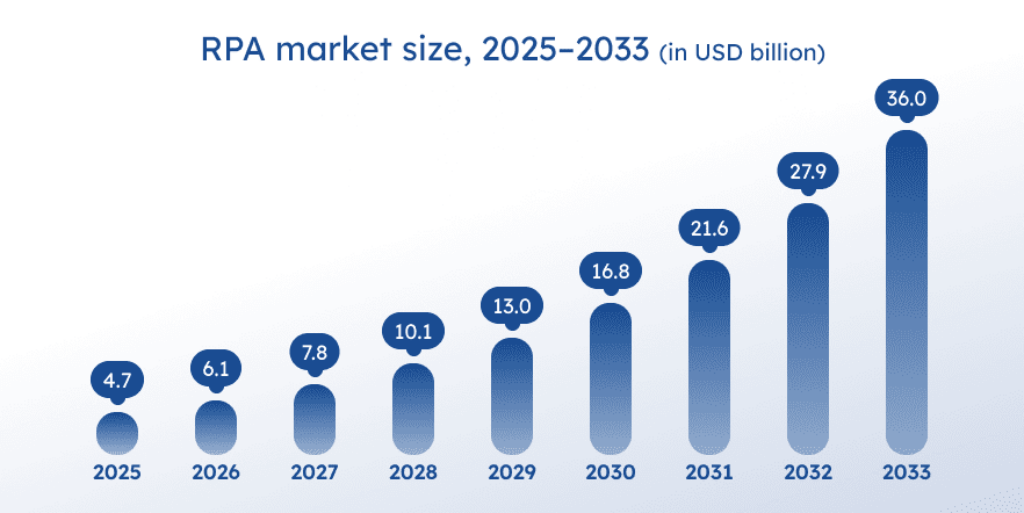
Robotic process automation, along with artificial intelligence and machine learning, is rapidly gaining popularity. In 2025, the global RPA market reached $4.7 billion and is expected to grow at a CAGR of 29% through 2033, reflecting the growing demand for operational efficiency and cost reduction.
However, not all processes can be automated – RPA limitations apply for complex, frequently changing workflows and unstructured tasks. There, the best option might be using cognitive automation (RPA + AI), business process management platforms, or human-in-the-loop automation. It’s always a company’s choice whether to rely solely on human employees or let robots handle some work.
Key RPA challenges to consider before adoption
RPA adoption can be trickier than you think. The Gartner survey found that the most common challenges in RPA implementation stem from employee resistance, planning gaps, and inefficient implementation. Let’s see it in more detail.
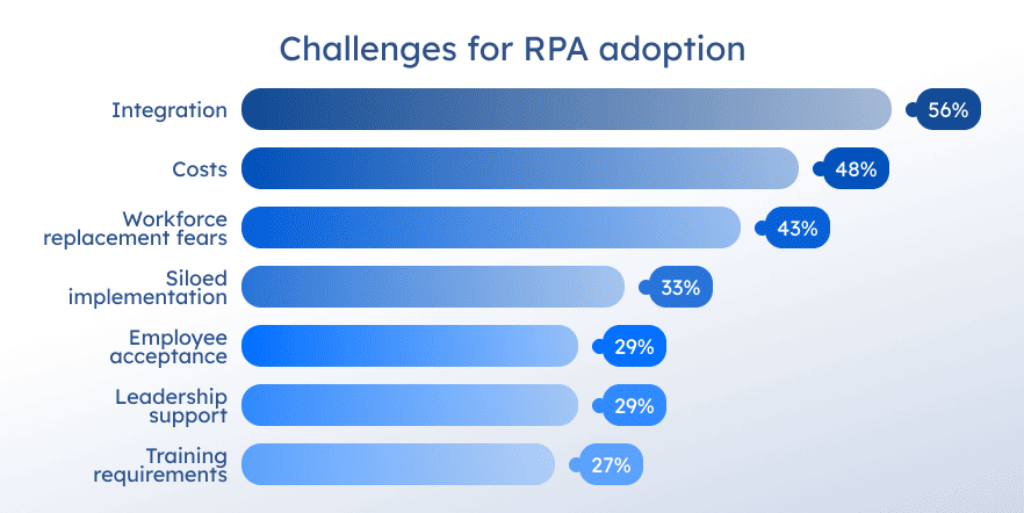
Top challenges for RPA adoption. Source
1. No clear RPA strategy
Implementing robotic process automation without clear objectives, priorities, and strategic alignment often results in wasted money and effort. RPA rollout without a well-thought-out strategy will lead to mismatched expectations, unreliable outcomes, and the derailment of automation success. One reason for poor planning may be a lack of stakeholder buy-in, leading to disconnection from business goals or insufficient resource planning.
Solution: when planning an automation project, companies need to design a detailed strategy that will articulate clear RPA goals. Such strategies typically include guidelines for defining processes, as well as for task evaluation and prioritization. Here is a list of actions to take to bring the RPA plan to life successfully:
- Department heads should determine what should be automated, selecting high-volume, repetitive, standardized tasks within high-value processes.
- Technology teams should provide employee training on the use of RPA tools and self-deployment of robots.
- Businesses should set up constant monitoring and management of processes in order to timely implement any changes.
- Organizations should create a plan that would address possible RPA issues and list down methods for their mitigation and elimination.
2. Choosing the wrong automation process
While some companies prefer automating everything, others focus on just one or two small processes, which can lead to significant improvements. Selection of unsuitable processes often leads to financial losses, poor results, and a mismatch of expectations and reality. So, how to select the right process for automation?
Solution: proper evaluation of processes for automation is necessary to avoid low ROI and high maintenance costs. The companies should look at the following:
- Frequency of execution. It is worth prioritizing processes used frequently, weekly, or even daily.
- Process complexity. If a process requires high-level cognitive tasks, it is not well-suited to automation.
- Resiliency. Fault-tolerant processes, such as routine customer communications handling, are better suited to RPA than error-sensitive tasks.
- Business impact. To get quick results from automation efforts, choose processes with high business impact (time-consuming tasks that directly serve customers).
3. Poor change management
Poor change management is an umbrella term that covers gaps in RPA integration from top-down implementation to insufficient training. You get unprepared, resistant to change employees, underused bots, and a lack of trust in the technology.
Solution: in order to succeed, every person whose work is touched by automation should know how to use RPA, how it affects their role, and what changes it brings, and acquire the necessary skills to fulfill new responsibilities. All these activities should be included in the RPA execution plan early, before the actual implementation. What else should be foreseen:
- Define process owners to avoid confusion among IT, operations, and business units. Clearly identify the process owners, bot owners, and escalating paths from the outset.
- A data-driven, standardized way of working can clash with existing working habits. Release RPA gradually, from pilot to scale, to smoothly transition the working culture.
- Your automation solution can be technically sound, but fail operationally. To prevent this, introduce structured communication and build trust into technology across the teams.
4. Security and compliance risks
Since robots perform specific internal tasks, they normally have access to the company’s sensitive data. Consequently, managing security risks and data privacy is one of the top priorities when it comes to RPA management. If access to data and validation of robots are not properly managed, this may lead to vulnerabilities in the system, data leaks, and unauthorized access to confidential information.
Solution: ensure that your automation processes are built with compliance in mind, retaining and handling data in accordance with the regulations. Then, introduce monitoring and audit trails to track, detect, and prevent security issues. Overall, there are more ways to mitigate security risks and adhere to compliance when it comes to RPA:
- Separate data access by assigning different roles to the RPA team, so that every employee has their level of access according to their responsibilities.
- Use the principle of least privilege: give bots only the permissions they need to complete their tasks.
- Assign a unique identifier to each robot to trace which robot executes a task in case of incidents and errors.
- Constantly check bots for vulnerabilities or inconsistencies. Review error and exception history to identify patterns and fix errors.
- Use encryption to secure bot credentials like usernames, passwords, or API keys so that they won’t be exposed to insiders or hackers.
5. Lack of coordination between the business and IT
Absence of organizational alignment between the business and IT is one of the most frequent causes for RPA implementation to fail. When the IT department solely manages RPA, employees may not be responsive enough to business needs and may not fully comprehend them. On the other hand, when the business solely manages automation, it may not understand certain technical aspects, which leads to poor RPA tool selection and maintenance errors.
Solution: to ensure that business and IT understand each other and communicate freely, companies can create an RPA Center of Excellence (CoE). CoE allows all stakeholders to share expertise and optimize process selection, prioritization, RPA development, and governance. While IT can focus on providing software that matches the company’s technical needs, the operations department can focus on organizational support and implementation strategy. Other coordination efforts include:
- Defining roles and responsibilities to avoid confusion between business and IT teams when choosing processes, handling infrastructure, and managing bots.
- Aligning performance metrics and objectives. Whether it is speed, cost reduction, or security, set clear KPIs to create common goals.
- Establishing communication channels to keep stakeholders on track. Organize regular meetings and create shared dashboards to track bot performance and system updates.
6. Process complexity
Sometimes, businesses have too many processes that it becomes hard to determine which should be automated or even qualify for it. The point is that RPA has its own limitations and does not perfectly fit complex or unstandardized processes. If your organization has workflows that often change, involve many exceptions, or handle unstructured data, they may not fit for robotic process automation.
Solution: to mitigate problems with RPA that require sophisticated workflows, start by reviewing your processes, standardizing, and simplifying them before automation. Apply RPA only to stable sub-processes, or use a hybrid approach that involves humans for judgment-based decisions. Other ways to handle the complexities include:
- Combine RPA with artificial intelligence to handle unstructured data, such as PDFs, scanned documents, and emails.
- Break complex workflows into smaller sub-processes that are suitable for automation to reduce failure rates and make maintenance easier.
- Run a pilot automation project before scaling – test RPA on a smaller number of cases. Once you reach stable performance, scale it up.
7. Integration issues
When your business ecosystem is complex, it can be hard to introduce RPA to connect all the dots. Some business software may not be designed to work together, lacking APIs and standard interfaces, while others might restrict bots’ access to some systems due to compliance rules. Overall, poorly thought-out RPA integrations lead to errors, longer processing times, and even downtime when unexpected behaviors occur between bots and systems.
Solution: to overcome difficulties with legacy system integration and systems connectivity, it would be a good idea to begin with a system audit before RPA implementation. It would get you a better understanding of the existing dependencies, interfaces, and workflows that may hamper your automation efforts. Here’s what you can do to ensure smooth integration:
- Connect bots to systems via APIs instead of mimicking mouse clicks or extracting data directly from a user interface, for stable, faster, and more reliable request execution.
- Use orchestration platforms to coordinate multiple bots, reducing system overload and ensuring proper task sequencing.
- Implement bot-monitoring tools that alert you to integration failures. Early warnings allow proactive troubleshooting and decrease downtime.
8. Lack of RPA expertise
When planning RPA adoption, you can find out that your in-house team does not have enough knowledge, skills, or experience for building and implementing bots into business processes. Automation projects are complex, as they include multiple stages from discovery to bot development and final deployment. Mistakes at any stage can be costly and hard to fix.
Solution: you can handle the lack of talent in several ways. If there’s no rush and you can postpone the project for several months, expand your in-house team, hiring individual professionals. If you want to launch RPA faster, you can turn to an outsourced dedicated development team. A reputable service provider can supply you with experienced developers and analytics in weeks, not months, meaning you can start your project faster and get real results sooner.
9. Implementation costs
A solid 37% of businesses tend to underestimate automation costs. As RPA implementation is a multifaceted process, you should carefully consider each step, from infrastructure preparation, bot design and configuration, development, to maintenance costs. It all requires significant automation investments, as RPA projects can cost anywhere from $20,000 for pilot projects to $500,000+ for enterprise-grade automation. Moreover, hidden costs can significantly escalate the RPA implementation budget and lead to project stalling.
Solution: at the planning stage, you should run a comprehensive analysis and count risks such as unexpected maintenance, customization needs, integrations, and compliance expenses. Take into account that 25–30% of your budget goes to licensing expenses, while 70–75% is spent on integrations, preparation of infrastructure, and maintenance. Here are some tips to avoid cost overruns:
- Include in your budget costs associated with employee training, bot testing, and system security.
- Outline project objectives, requirements, and define deliverables to prevent scope creep. Create specific procedures for handling change management.
- Track ROI continuously and adjust your strategy in case expenses exceed the expected benefits and value.
10. Lack of suitable infrastructure
Without the proper infrastructure to support RPA deployment, companies may not get the results they expect. If the existing infrastructure system is outdated, inflexible, and slow, it will be difficult to adopt bots and achieve time and cost savings. Unfortunately, not all companies analyze and optimize their IT infrastructure before implementing robotic process automation, and as a result, it backfires.
Solution: before RPA adoption, a company needs to think about the required capabilities and define whether the existing infrastructure can support RPA. The main criteria for an RPA-friendly infrastructure are:
- RPA tool support for virtual environments to ensure easy scaling and increase bot workload handling.
- RPA tool licensing model support to determine how many bots you can involve in automation, on what terms, and where they will run.
- Application update policies to maintain bot compatibility with the app’s version, predictable maintenance, and reduced security risks.
- Efficient system performance to run all your scenarios without disruptions, including short response times, a stable network, and available computation resources.
- High uptime (99.5%) to schedule bots when the systems are available and avoid interrupted transactions.
11. Employee resistance
Introducing automation can be stressful for employees. Considered as a threat to their jobs, the adoption of such tools might be sabotaged in various ways, from negative talk about automation to withholding process knowledge. Many fears and beliefs stem from a lack of understanding of RPA’s purpose, benefits, and how it would change job roles.
Solution: addressing employees’ concerns about RPA implementation is the best way to meet this challenge. Start by explaining what RPA will not replace, how exactly people’s roles will change, and reframe bots as employee assistants, not antagonists. Then, continue with educational videos and workshops that explain how new processes work and why they are trustworthy. Here are the activities you can add:
- Clarify how automation works and remove any technical uncertainties. Showcase successful examples and how they improve metrics and facilitate human work.
- Listen to people’s opinions on RPA and make them feel heard and valued. Validate their concerns to build trust and mutual understanding.
- Include employees in the design and testing of the bot. Let them see how PRA automation works from the inside and ask them to help document processes.
- Train your staff to perform more complex work instead of the routine manual tasks they did before introducing automation.
12. Staff retraining
The biggest advantage of RPA is freeing employees’ time spent on entering data from emails into CRM systems or manually processing purchase orders. In theory, it means your staff can switch to more creative, complex, or high-priority work. In practice, people arrive unprepared for new workflows and responsibilities. Without proper training and reskilling, you cannot expect a fast transition to new processes and seamless workforce adoption.
Solution: include staff training in your RPA implementation plan. Define existing skill gaps, develop training programs, and prepare your team not only for automation handling but also for more complex tasks it will face as a result. For example, an employee previously entered invoices in the system. When you automate this process, it becomes clear that the employee can now analyze financial trends or handle exceptions. Here are more ideas on how to support your teams:
- Create employee classifications according to the training they require: ready, needs training, and needs reskilling.
- Provide specialized courses for managers, IT staff, and business users according to their future tasks. Offer mentorship and support in the adoption of new technologies.
- Emphasize practical skills. Create sandbox environments where employees can safely test RPA tools.
- Do not force transition. Ensure that you give your team manageable tasks first, provide transit to new roles smoothly, and give feedback to adjust expectations and training.
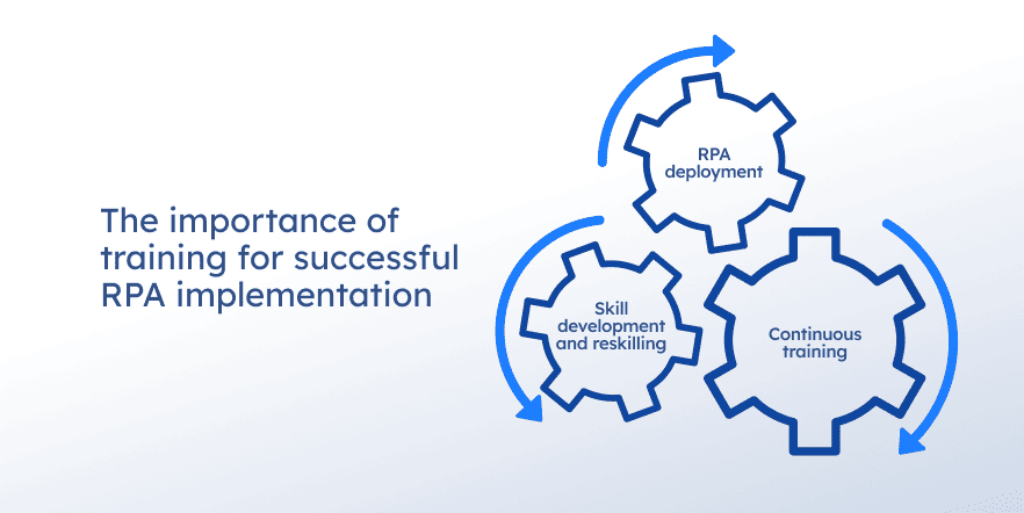
The importance of training for RPA implementation. Source
13. Bot management and maintenance
RPA technical support is critical to avoid errors. If the system is not regularly updated and RPA maintenance protocols are ignored, the environment will degrade over time, leading to errors, failures, and downtime. Without proper oversight, bots can become slow or unpredictable. They may misread or skip data required for task completion, therefore providing inconsistent or corrupted data.
Solution: to prevent RPA project failures associated with bot management and ensure RPA processes perform as intended, companies need to assign a responsible specialist or team. Designated point of contact would be responsible for the following tasks:
- Ensure that all necessary updates and patches are applied to the system and that all changes are documented.
- Take care of the data integrity by copying data from temporary storage to larger storage to prevent data loss.
- Run endurance tests to verify if the system can provide stable performance under different loads.
14. Scalability issues
According to Forrester, only 52% of enterprise RPA initiatives succeed in scaling beyond the first 10 bots. One important aspect of RPA implementation that companies tend to overlook is that their system should often support a large number of RPA robots that perform multiple processes. These processes can be difficult to scale due to regulatory updates or internal changes. Hence, companies should consider how they will scale up as the workload grows.
Solution: for enterprise-level automation, it’s important to assess business infrastructure, RPA governance, bot design, and management early on. The best practices for scaling RPA automation include:
- Scale by increasing the number of robots, not by complicating the processes. Intelligent distribution of processes among robots contributes to more efficient scalability.
- Consider process mining tools. Analyzing event logs can help businesses optimize their workflows before automation, thereby facilitating future scaling.
- Review robots’ designs to favor reusable architecture. Reusable components can help you reduce maintenance efforts and avoid task/bot duplication.
- If you still haven’t thought about migrating to cloud or applying hybrid infrastructure, it might be the right time to consider them for easier scaling.
- Sometimes, when the system becomes too complex, a good option will be to evolve RPA into hyperautomation, adding more tools that provide end-to-end automation.
Final thoughts
Common challenges in robotic process automation deployment arise from insufficient planning, the absence of change management, and a shortage of RPA-skilled professionals. Organizations can overcome them with thoughtful strategy development, where all automation decisions align with business objectives and have executive support.
If your project lacks in-house expertise, consider hiring external professionals. SoftTeco helps companies to implement, enhance, and maintain automation, creating individual development strategies aligned with business needs. Reach out to book a free, non-binding consultation and get a project cost estimate.




Comments