
IT infrastructure optimization has evolved from focusing mostly on cost reduction to prioritizing scalability and growth. In the era of AI and cloud computing, organizations pursue agility and performance, aiming for faster operations, data-driven decisions, and competitive advantage.
A good infrastructure allows businesses to move from routine maintenance to strategic initiatives. In our comprehensive guide we explore diverse aspects of infrastructure optimization, discover its benefits, unveil complexities, and explain how to do it right.
What is IT infrastructure optimization?
First, let’s take a look at the concept of technology infrastructure. In essence, it is a combination of hardware, software, and network resources that build a foundation of any business operations and management. It includes two types of components.
- Physical elements include PCs, servers, and routers.
- Non-physical parts encompass operating systems, cloud services, and applications.
They are all used for data storage, processing, and communication, and ensure that the organization runs smoothly and efficiently.
Infrastructure optimization aimed at rational resource use and cutting extra expenditures. It improves business’s technological environment for more efficient, secure, and economical operations. The process can be launched at any time, yet yields the highest ROI when done during business restructuring.
Improving IT infrastructure has become essential for businesses: the global IT spendings are projected to reach $5.43 trillion in 2025, up 7.9% from 2024. Artificial intelligence, regulatory compliance, technical debt, and cloud adoption are the major factors that contribute to this investment growth.
For organizations, it means that the earlier they begin optimizing their infrastructures, the greater the profit they will achieve in the future. You can start by requesting IT infrastructure support from a reputable company. It will help you identify inefficiencies and draw up a roadmap for future improvement.
Types of digital infrastructure
There are three types of IT infrastructure: on-premises, cloud, and hybrid. Each of them has its own optimization strategies. Still, all are united by the need for regular audits and strategic planning.
On-premises
A traditional infrastructure that is owned by business and placed entirely within its physical facilities like server rooms and data centers. A common optimization strategy for this type is cutting down the number of machines in the data center, processors, or memory capacity. Nevertheless, companies need to ensure their systems would maintain workload even at peak times.
Cloud
Choosing cloud means that business’ infrastructure is moved from physical facilities to remote computing resources. Service providers are responsible for its maintenance, updates, and smooth running, while the company pays for the capacity they need. Cloud optimization strategy includes running regular audits or automating resource consumption, developing a solution that runs cloud infrastructure on demand.
Hybrid
As the name suggests, this type combines the previous two, allowing organization’s workloads, data, and applications to operate across both environments. The choice of workload location is often dictated by cost, performance, and compliance. Here, optimization approaches include clear workload placement, data synchronization, and cloud usage monitoring.
IT infrastructure optimization process
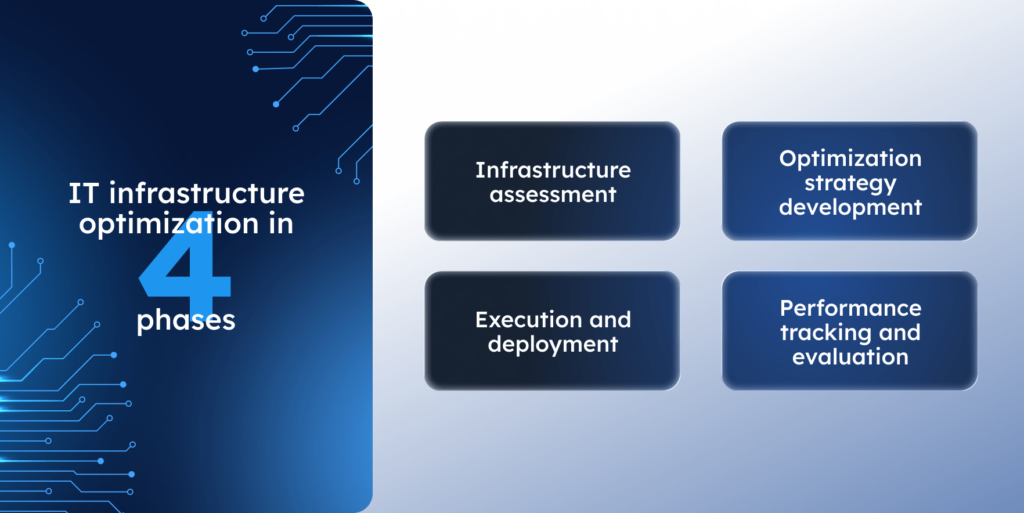
IT optimization can take several forms and approaches depending on type, your business objectives, and resources on hand. Yet, the core procedures lie at four cornerstones: analyze, plan, modernize, align.
1. Evaluate your infrastructure
Start by auditing your current IT infrastructure: existing systems, applications, hardware, and networks. Decide why optimization is required in the first place, look for weak points, cost inefficiencies, and forecast how the optimized infrastructure will perform. Collect metrics to identify performance gaps, outdated components, or any other inefficiencies and risks. The results of this assessment will highlight the bottlenecks.
Here are the main indicators you need to check:
- CPU utilization
- Memory use
- Storage capacity usage
- Disk IOPS
- Storage latency
- Bandwidth use
- Network latency
- Service availability
- Incident frequency and severity
- Hardware age and lifecycle status
The list of technology health metrics is not full and should be further specified by the IT team to give you a 360-degree overview on your system’s performance, capacity, reliability, and security.
2. Develop optimization strategy
Now it’s time to analyze the findings of the previous stage of work.
First, identify the areas that limit your operations and business growth, and prioritize them by their highest impact on cost, efficiency, or reliability. Define measurable deliverables for the optimization process and check their alignment with business goals and SLAs. Moreover, conduct risk assessment to identify areas that can be a security, legal or compliance issue.
Second, determine optimization approaches.They will vary depending on your infrastructure type – on-premises, cloud, or hybrid:
- Strategies for on-premises infrastructure may include server virtualization or consolidation, e.g., migration to the cloud, hardware upgrades, and implementation of resource utilization monitoring tools.
- Techniques for cloud upgrades include rightsizing cloud instances, applying auto-scaling, storage tiering, using cloud-native security and monitoring tools, and automating deployments.
- Initiatives for hybrid infrastructure might include most of the activities from the previous two sections, as well as workload distribution across environments, its automated placement, and the introduction of monitoring and management tools.
Third, plan your resources. Estimate costs, timelines, and required technical staff, as well as tools, software, and hardware you’ll need. If you don’t have enough for a comprehensive modernization, don’t worry. That shouldn’t be a one-time, big event; you can start with smaller changes that nevertheless make a difference.
Finally, you create a phased plan that includes milestones, timelines, and a mitigation strategy. You also need to run a solid risk assessment to avoid challenges connected to a lack of integration between development stages and stakeholder misalignments.
3. Implement changes
At this stage, you focus on gradually introducing planned improvements. The vital point here is to minimize disruptions while integrating optimized solutions. You can orchestrate deployments, perform high-impact changes during off-peak hours, and make a full backup before implementing changes, so all the work won’t affect user experience.
Don’t forget to test your systems: conduct functional, performance, and security testing. This will allow you to validate improvements, verify capacity and scaling. You can also apply user acceptance testing where it is relevant. Then, measure early performance indicators against optimization objectives to evaluate the optimization’s early impact.
4. Monitor infrastructure performance
Post-launch system monitoring ensures that the system works as intended. You still collect relevant metrics on infrastructure performance and resource allocation, analyze indicators, and look for new ways of improvement. Then the cycle repeats.
The core activities at this stage include:
- Configuring dashboards and metrics
- Setting alerts for abnormal patterns
- Forecasting demand and capacity
- Monitoring application response times and error rates
- Providing regular performance reports to stakeholders
- Implementing iterative enhancements based on monitoring insights
Key benefits of infrastructure optimization
Optimizing hardware, software, and networking infrastructure today is essential for businesses that want to succeed in the competition. Growth of unstructured data, cybersecurity threats, and regulatory hurdles make optimization a strategic demand, encouraging organizations to seek the benefits it can bring.
Improved performance and reliability
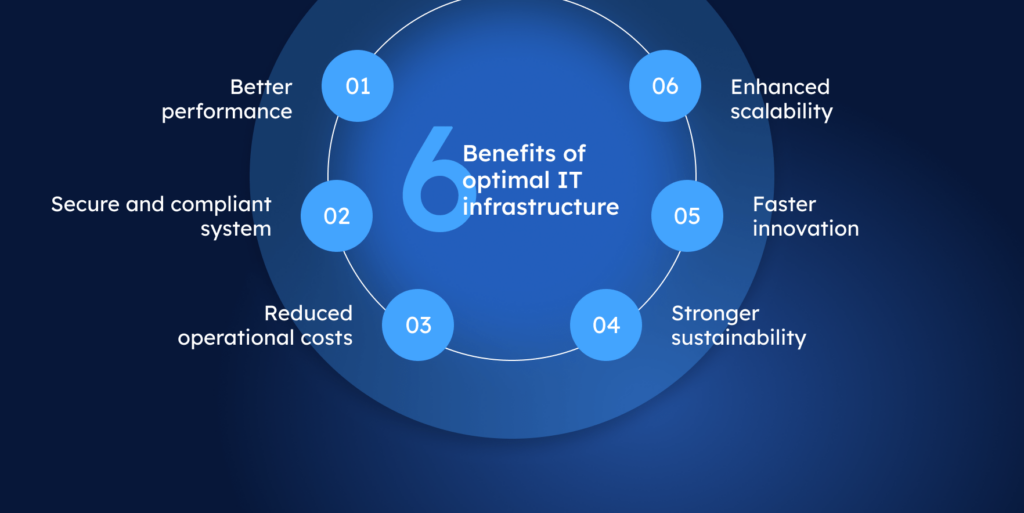
Timely IT environment upgrades ensure that all system components perform at their best and support business functions. They can enhance customer experience and employee productivity providing faster system response, lower latency, and higher uptime. In addition, optimized resource allocation ensures that customer-facing services are always well-provisioned. Businesses that opt for infrastructure optimization get systems that are fast, easy to scale, and highly available to employees and customers.
Cost efficiency
Rightsized infrastructure can cut costs by 36%, and that’s not the limit. Consolidation of servers and cloud services helps keep costs down, allowing companies to achieve a fit-for-purpose infrastructure. An optimal IT infrastructure can reduce the total cost of ownership by cutting unnecessary CPU or memory usage, extra licensing, or switching off idle environments.
Enhanced security and compliance
Cyberthreats are still the major challenge for companies around the world. Nearly 94 million data records were leaked worldwide in Q2 of 2025 alone, causing fines, operational disruptions, and reputational losses. Fortunately, infrastructure improvements make environments more standardized, observable, and easier to control.
During optimization, companies remove outdated systems, implement multi-layered defence strategies, and improve access control, enhancing system security and compliance. Centralized monitoring and mapping of every infrastructure component increases visibility, allowing better threat detection and faster response.
Scalability and future readiness
System refinement also allows businesses to expand, adapt, and innovate without the delays. Optimized systems can easily scale up and down and grow both vertically and horizontally without major redesigns. A thoughtfully upgraded infrastructure not only has better response to demand spikes; it also allows companies to minimize the impact of hardware failures, outages, or human error.
Organizations that handle IT environment right-sizing more easily implement new practices such as real-time data analytics, federated data governance, and ethical AI use, strengthening business continuity and customer trust.
Better sustainability
When organizations shift to energy-efficient environments and decommission underutilized infrastructure, they not only save costs, but contribute to environmental sustainability as well. By cutting carbon emissions, businesses demonstrate adherence to modern corporate responsibility standards and alignment with ESG targets.
Companies achieve better sustainability through:
- Removing redundant data center equipment to reduce energy consumption;
- Optimizing CPU/GPU and storage resources for lower heat output;
- Implementing autoscaling to lower compute hours and, therefore, carbon footprint;
- Replacing old equipment for optimal energy draw and decreased CO₂ emissions;
- Moving “cold” data to archival or low-energy storage to reduce power demands.
Hidden costs of poor infrastructure
Inefficient infrastructure not only poses security risks but also incurs hidden costs that are not obvious at first glance and drain companies’ budgets.
Downtime impact
Flawed infrastructure often causes downtimes, and even small ones can have larger consequences. From lost transactions and customer churn to reputational damage, they all lead to lost revenue. This fact is supported by the research: it states that the largest public companies lose ~$200 million yearly due to unexpected downtime caused by digital disruptions.
Security and compliance failures
Outdated or underperforming systems are a primary target for hackers, as they include well-known vulnerabilities: outdated applications and operating systems, missing security updates, and weak security controls. Data breaches and phishing attacks can lead to losses ranging from hundreds of thousands to millions of dollars: the global average cost of a data leak has reached $4.4 million per incident.
Another hidden cost of unoptimized infrastructure includes fines for noncompliance with regulations such as GDPR, PCI, and HIPAA. For example, cloud misconfiguration led to exposure of 1.5 million (3TB) of airport employees data in 2021. Leaked materials include photos of ID cards, workers, planes, fueling lines, etc. The fees for security violation could reach up to $400,000 for the security company, while affected airports could face security infiltration, fraud, and scams.
Low employee productivity
Slow apps decrease employee productivity. Long loading times, frequent reboots, crashes, lag, or connection issues are shifting the IT team’s focus from the actual tasks to “firefighting” the issue. It results in minutes and hours spent on struggling with the sluggish systems instead of working on strategic projects.
Bad customer experience
Underperforming applications, buggy interactions, and messy checkouts are all the reasons why your customers will never come back again. For businesses, it means negative reviews, lost sales, lower conversion rates, and higher churn. Around 50% of customers switch to competitors after a single bad experience, and that number rises to 73% after several bad experiences. In terms of money, such an impact is significant but hard to measure, as the customers often silently leave your website, mobile app, or service delivery due to poor performance.
Complex maintenance and technical debt
Infrastructure and IT operations leaders are facing technical debt on the largest ever scale, as over 40% of their systems turned out to be beyond end of life or support in 2025. The research shows that 65% of organizations spent twice that they used to in 2019; over $2 million was allocated on legacy system support in 2024. However, maintenance does not solve the problem. Outdated hardware and software are costlier to maintain year to year. In the long run, such costs outweigh the price of full modernization.
5 tips on how to optimize your IT infrastructure
While there is no one size fits all approach for IT optimization, there are prevalent strategies that can help you to achieve your business objectives.
Conduct regular assessments
IT optimization is not a one-off event; to get a future-ready, reliable system, you need to improve it continuously. As new technologies emerge and existing ones advance, you need to assess your infrastructure regularly to keep pace. High-growth environments require more attention than moderately dynamic ones; yet, each organization schedules such checks individually. In case you implement major changes to your infrastructure, such as hardware updates or cloud migration, this assessment should also be performed to ensure security, compliance, and availability.
Embrace cloud technologies and automation
Migrating traditional infrastructure to the cloud – fully or partially – is one of the prior techniques to improve your infrastructure. For business it delivers reduced maintenance and overhead costs, and elastic scaling.
- Microservices and containerization, supported by Kubernetes, and Docker allow you to build modular and highly available applications.
- The use of Infrastructure as Code with tools like Terraform allows you to configure, and manage servers, networks, and storage automatically.
- Introduction of tools such as Datadog, Prometheus, or Splunk helps you track operational performance, resource utilization, system’s availability, and handle increased loads effectively.
- Routine tasks automation accelerates your IT operations, freeing up your team’s time, so they can focus on strategic initiatives instead of manual patching, backups, deployments, and compliance reporting.
Standardize and consolidate systems
Disparate tools, systems, and platforms cause loose governance, extra costs on excessive configurations, and complex infrastructure management. One of the ways to optimize IT infrastructure is to reduce the number of its components to the amount that covers an organization’s needs. You can start with finding the systems with duplicating or overlapping functionality, then moving to standard platforms and toolchains. Migrate workloads to fewer, but more capable platforms, removing the need for legacy solutions, or at least reducing dependency.
Another vital point is to consolidate network systems. A stable and predictable network makes your business more secure and automation-ready.
- First, you can standardize your hardware platforms. Reduce the number of switch, router, and firewall models across the environment, use standardized modules and cabling, and select vendors or product families for easier lifecycle maintenance.
- Second, consolidate firewall, DNS, and NAC services, removing redundancies. This will help to decrease fragmentation between vendors and solutions, facilitate troubleshooting, and make the network more manageable.
- Third, simplify network architecture by cutting unnecessary layers and consolidating legacy networks into unified architectures. That leaves less room for configuration drift, reduces the number of edge cases, attack surfaces, and risk of inconsistent access.
Invest in monitoring and analytics tools
System health tracking and performance analysis help businesses quickly detect inefficiencies and guide load balancing, ensuring adequate capacity even during peak times. Centralized monitoring is necessary for modern infrastructures, as it provides unified visibility into processes, workloads, and key metrics such as server uptime, response times, and network latency. Performance auditing tools such as Prometheus and Grafana ensure that infrastructure aligns with business objectives. Similarly, data analysis helps reveal new optimization opportunities and accurately forecast resources for planning and budgeting.
Prioritize sustainability and energy efficiency
A developed yet inefficient IT infrastructure increases energy bills and leaves a heavy carbon footprint on the environment. Energy-efficient systems, on the other hand, convert into real cost savings and a greener economy. With the rising electricity costs and growing need for computing resources, it is a solid investment in the future.
The main approach to a more sustainable IT infrastructure includes server virtualization, e.g., shifting to cloud services. Cloud providers, standing at the technology forefront, invent and apply more efficient methods for optimal energy consumption. For instance, Google Data Centers report 84% less energy overheads compared to the industry’s average for every unit of IT equipment energy.
Another way is to upgrade old hardware to modern servers, storage devices, and network appliances. Newer equipment has higher performance per watt and generates less heat, resulting in lower cooling energy consumption. It also has greener features. For example, low-power idle states help infrastructure devices reduce electricity consumption when not fully active. Nevertheless, they are not switching off, but entering sleep mode instead, remaining ready to resume full performance fast.
Real-world examples of successful optimization
At SoftTeco, we build and implement custom optimization strategies for our clients, based on their requirements, priorities, and compliance needs. Here are some examples of successful work we performed.
C2 SmartLight
At the C2 SmartLight project, the client wanted to update their outdated, 10-year-old smart lighting control system. Our development team started with backend optimization, achieving better system scalability and performance. Then, we built control programs for lighting networks. This feature leads to a ~20% decrease in electricity use and lower CO₂ emissions, resulting in not only energy cost savings but also improved sustainability. Finally, SoftTeco centralized system management, allowing users to adjust dimming levels, make lighting adjustments, and monitor device status.
Artlist
At the Artlist project, the client approached SoftTeco with a request to optimize the performance and architecture of their platform for video creators. Our team migrated the backend to .NET and optimized cloud infrastructure, facilitating integrations and boosting system efficiency. We built and deployed to cloud an ML-powered recommendation system that enhances the user experience through personalization. In addition, our experts rewrote the frontend using React.js, introducing better navigation and layouts aligned with the brand’s fonts and colors. As a result, the client received a revamped, integrated platform that scales easily and performs well under high load.
The future of infrastructure optimization
As IT infrastructure continues to transform, fuelled by evolving business needs and emerging technologies, new trends emerge for its efficient management, monitoring, and use. Let’s check the major directions that will shape the future of innovation-driven organizations.
Prevalence of hybrid cloud use
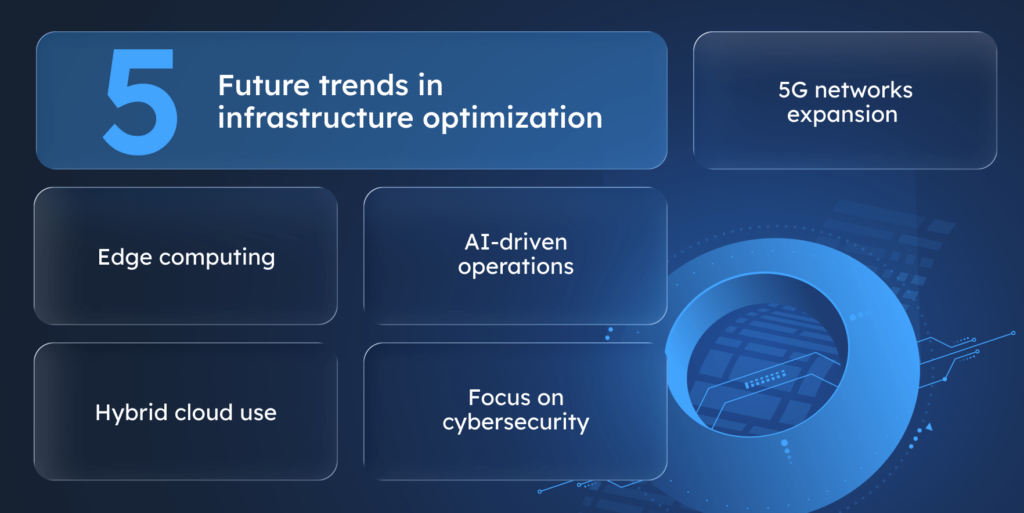
Gartner predicts that by 2027, 90% of organizations worldwide will adopt hybrid cloud, as businesses continue to look for cost-efficient and scalable solutions. The convenience lies in the flexibility of placing workloads where they perform best: scalable and elastic workloads can be put in the public cloud, while high security workloads run on-premises. The pay-as-you-go model of cloud providers also adds convenience and allows them to cut capital expenditures.
More AI-driven operations
More and more businesses are integrating AI to streamline their operations. The technology can fulfill a variety of tasks, from predictive maintenance, which foresees system failures and makes fixes before downtime happens, to enhanced decision-making with the help of intelligent analytics.
Artificial intelligence also enhances automation, so businesses can manage system performance and adjust resources with little human interference. Such oversight of infrastructure components like servers, storage, and networks reduces human errors and optimizes workloads.
Stronger focus on cybersecurity
Modern problems require modern solutions. While cyberattacks’ aftermath becomes more and more costly, organizations will increase investment in secure infrastructure, implementing zero-trust architecture and AI security solutions.
The demand for smart, reliable tools is proven by the AI cybersecurity market size: it was valued at $25.35 billion in 2024 and is projected to grow up to $93.75 billion by 2030. Businesses will continue to apply AI security tools for early threat detection, combining them with conventional practices such as data encryption and multi-factor authentication.
Edge computing advancement
Edge computing moves processing and data handling closer to the source – device, sensor, or machines – to reduce latency, keep sensitive data on-site, and decrease reliance on the cloud. Sending data to the cloud rather than on-site handling is often expensive, slow, and unnecessary, especially for technologies that require lightning-fast responses, such as AR/VR and real-time analytics.
In 2024–2033, the edge computing market will see substantial growth, increasing from $23.65 billion to $327.79 billion, highlighting global demand for fast data processing. The trend is also driven by the expansion of 5G networks and the potential of AI deployment at the edge. For IT infrastructure, it marks the switch from centralized to distributed architectures, the growth of small, modular data centers, and the rise of software-defined and autonomous infrastructure.
5G networks expansion
5G networks opened the new era of connectivity, delivering higher wireless data transmission speeds, lower latency, and robust device density. That’s why moving to 5G changes the ways organizations design, deploy, and optimize their IT infrastructure. The technology expands IoT adoption, supports real-time apps, and strengthens mobile workforce performance, allowing companies to build faster, more responsive, and more scalable digital systems.
Conclusion
IT infrastructure optimization, when handled thoughtfully, results not only in cost reduction but also in innovation-ready operations. Technologies like cloud computing, artificial intelligence, and real-time data processing are pushing IT infrastructure to be dynamic, and businesses to be more agile.
The core optimization activities depend on infrastructure type and generally include hardware updates, networking improvements, cloud resource fine-tuning, and system consolidation. This results in more scalable, sustainable, and secure ecosystems.
Infrastructure improvement is an iterative process. Once done, it requires regular auditing, monitoring, and adjustments for flawless operations. While resource constraints can hamper the optimization, it shouldn’t be a full-scope implementation, but can be done gradually, handling one inefficiency at a time. If you need professionals for your infrastructure optimization projects, SoftTeco is ready to help. Contact us to discuss the details and get scope and cost estimates.






Comments