
As internet of things technology is on the rise across almost all industries, businesses are heavily investing in IoT app development. With it, companies can improve operational efficiency, customer experience, and decision-making.
Unlike traditional software creation, the development of IoT applications is more complex, as it includes hardware integration, connectivity, device management, and security considerations. The cost can considerably vary. It depends on system complexity, industry and project requirements. If you plan to develop an IoT system but still have doubts, this article breaks down how much an IoT app actually costs with detailed cost estimates.
IoT app development: statistics
Before we pay close attention to IoT app development cost, let’s consider how fast and widespread the technology is evolving.
According to Future Market Insights, the IoT app development services market is going to reach $117.3 billion by 2035, compared to $29 billion in 2025. The global IoT market is steadily expanding across different regions and industries with CAGR 15.0% from 2025–2035.
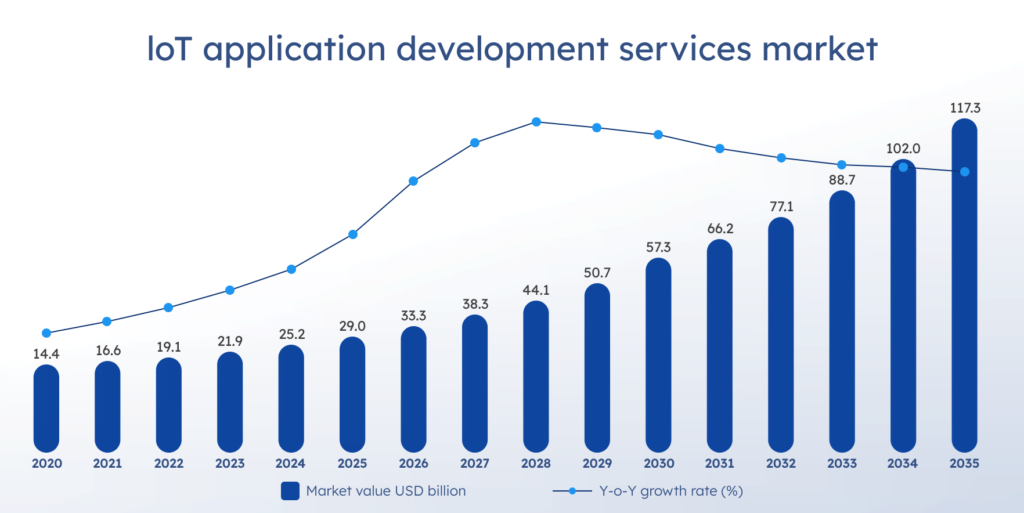
IoT application development services market. Source
As the pace of adoption accelerates, the internet of things is becoming deeply entrenched in key industries such as manufacturing, retail, healthcare, automotive, and energy. The widespread adoption of this technology is already finding application within organizations. Nearly 71% of companies use IoT, and more than 15 billion devices are connected to the network.
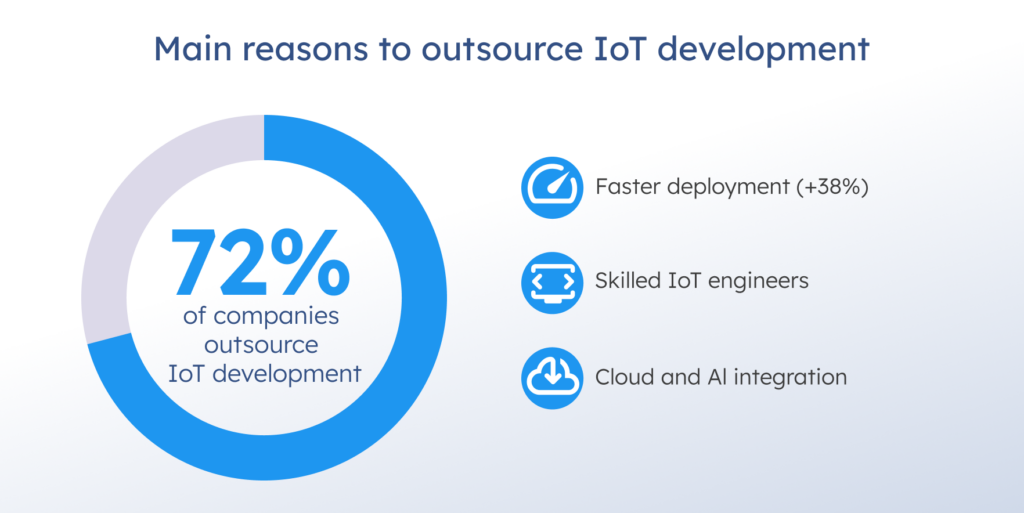
Approximately 72% of enterprises outsource the development of IoT solutions. The primary reasons: faster deployment by 38%, access to skilled IoT engineers, and integration with cloud and AI systems.
When implementing IoT technology, companies encounter various challenges: most frequently, these involve integrating IoT into business processes (70%), data management (48%), and identifying suitable use cases (40%).
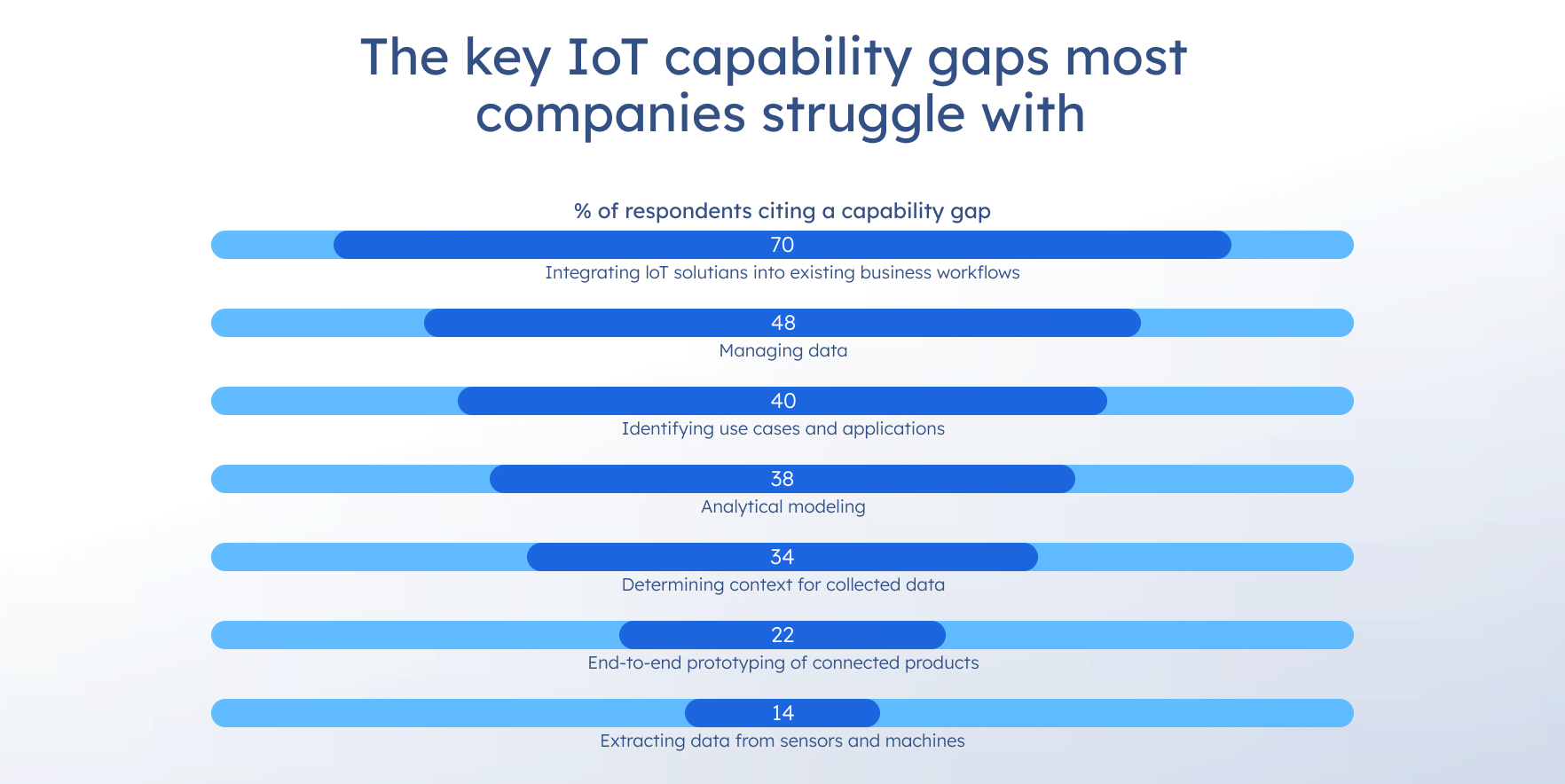
The most common IoT capability gaps. Source
When it comes to the benefits of IoT for organizations, operational optimization stands out as the most significant, accounting for 41% of its potential economic value by 2030.
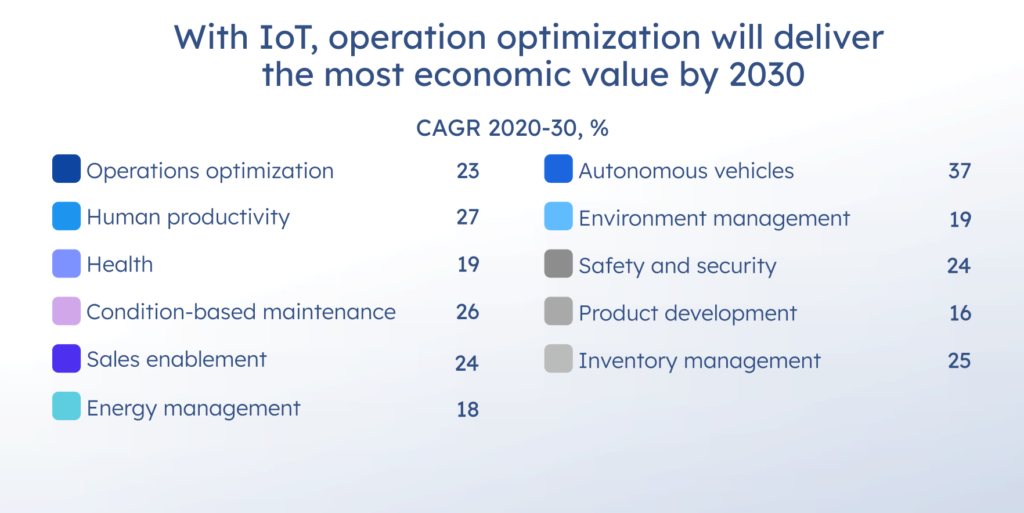
Estimated economic value of operations optimization with IoT by 2030. Source
What really drives IoT development costs
When it comes to IoT development, the real complexity often starts beyond the application interface. Device integration, connectivity stability, data flows, security, and long-term maintenance define whether the solution will remain reliable at scale. A successful IoT product refers to an ecosystem in which hardware, software, cloud infrastructure, and data management work together in a consistent and secure manner.
Unlike traditional software, IoT solutions must be designed for real-world conditions: unstable networks, offline devices, firmware updates, growing data volumes, and continuous security risks. All of these factors add up to the total cost of IoT system design. In general, the final cost of IoT app creation depends not only on the number of screens or features, but also on how devices communicate, how data is processed, how the system scales, and how securely it operates and will do so over time.

IoT app development cost by stages
On average, the cost of an IoT application ranges from $30,000 to $200,000+ and depend on architectural complexity, device connectivity, hardware, integration, and security needs, as well as team location, expertise, and project requirements. It is important to note that hardware, device certification, firmware, cloud usage, connectivity fees, and long-term support are often estimated separately.
To understand how the numbers are derived, let’s look at the IoT development process and the costs for each stage.
Stage 1. Research and project planning ($1,000–$8,000)
First of all, you should define clear and realistic business goals you want to achieve through IoT development. You can assign analysts and product managers to conduct in-depth analysis of the market, competitors, and the existing products. After that, you need to come up with a detailed plan that outlines project scope, development team, timeline, resources, risks, roles and responsibilities.
At this stage, businesses decide the budget for the entire IoT project. The more complex your application will be, the higher will be the cost. Poor planning in the initial stages often leads to rework, which usually requires extra time and money. The discovery stage for a small project with minimal planning costs around $1,000–$3,000 while an enterprise one that includes integration with many devices and services may require $3,000–$10,000.
Stage 2. IoT architecture design ($5,000–$30,000)
At this stage, you need to create the IoT solution architecture. It refers to a structured plan on how various components will interact with each other and enable the collection, transmission, processing, and analysis of data in real time. IoT architecture typically includes six layers:
- Perception layer contains IoT devices, actuators, sensors, as well as identification technologies such as RFID and QR codes. It ensures the collection of raw data from the physical world and the system’s interactions with it.
- Connectivity layer involves I communication networks, protocols, internet gateways, and edge devices. It supports bidirectional communication between the perception layer and other layers, enabling both sensor data collection and actuator control.
- Data processing layer consists of various tools and technologies, including databases, data centers, big data warehouses, data processing, analytics platforms, AI and ML. In this layer, raw IoT data is stored, processed, and analyzed.
- Application layer includes mobile, web, desktop, and smart-device apps that allow users to access and manage IoT devices with ease.
- Process layer defines workflows, monitoring, governance, and device management processes to maintain the efficiency, compliance, and reliability of the IoT ecosystem.
- Security layer is vital to protect all IoT system layers and data through specific measures and ensure system resilience against cyberattacks and unauthorized access.
Depending on the size of the IoT project, the cost at this stage varies from $5,000 to $30,000. Errors or underestimation of costs at this stage almost always lead to a dramatic increase in price in subsequent stages of IoT development.
Stage 3. UX/UI design ($5,000–$20,000+)
At the design stage, companies develop an application architecture that includes the user interface (UI), and user experience (UX). For this, designers create wireframes and mockups, followed by the initial prototypes. They help to understand how users will interact with the app and how devices will communicate. If you want to take your app to the next level and add complex features, such as a fully branded interface or animations, IoT development costs are likely to be higher.
The more complex and customized the design you want, the more expensive and longer it is to build. The design of a simple IoT app cost around $5,000–$10,000, while a complex one can reach up to $20,000+.
Stage 4. Software development ($30,000–$100,000+)
This is a core stage of IoT app development, where developers build the actual product. But before a full-fledged IoT app building, many companies prefer to develop a minimum viable product (MVP). It allows them to test the key functionality of the system and obtain feedback from early users before committing significant resources and funds.
The cost of an IoT app depends on system functionality, number of devices, security, and scalability requirements. The more complex the system, the more intricate its architecture becomes and the higher costs. Typically IoT app development includes backend, frontend, device communication, cloud integration, and APIs development. Backend design involves creating server-side logic that processes data from IoT devices and analyzes the information in real time, plus setting up cloud infrastructure. The backend of the IoT system typically costs from $15,000 to $100,000+.
Next, developers create interfaces that allow users to monitor devices, analyze data, and manage system settings. Such solutions include real-time updates, data visualization, and responsive design, which increases development effort. The frontend development of the IoT solution can reach $10,000–$80,000+. Another key moment is building APIs to connect different systems, third-party services, and tools. API development typically costs $5,000–$50,000+ and is determined by the number of integrations.
Stage 5. Quality assurance and testing ($10,000–$100,000+)
IoT testing is more expensive than traditional testing because it involves both hardware and software validation across multiple environments. Each component of an IoT solution should be tested separately: devices, networks, and software, which increases costs. To ensure a secure data and IoT ecosystem, you need to pay attention to performance, interoperability, security, network and other types of testing and incorporate security measures from the ground up.
Thus, basic testing of a small IoT MVP solution costs between $10,000 and $30,000, while testing a medium solution with multiple integrations and devices can cost $30,000 to $60,000. It’s a completely different matter with enterprise IoT systems that go for over $100,000. You can save money with testing automation. So it is better to approach testing sensibly: automate wherever possible, and use manual testing where it is not.
Stage 6. IoT system deployment and maintenance ($2,000–$25,000+)
This phase involves deploying the solution to the target environment and integrating it with other systems. Deployment costs depend on the scale of the solution, number of connected devices, and complexity of architecture. After that, you need to regularly invest in ongoing maintenance.
During this stage, developers set up the infrastructure, connect devices, and configure cloud services, edge computing systems, and networking components. Engineers also integrate the IoT app with third-party systems, platforms, or analytics tools. After all is done, a software provider can train employees and administrators on the new IoT system through prepared technical documentation, onboarding, and support materials. Training can add several thousand dollars to the overall deployment budget, increasing costs.
Finally, you must ensure ongoing maintenance and support of their IoT solution. These tasks include regular monitoring and diagnosis of devices, networks, and software; updating firmware and software on devices; conducting security audits; and providing remote support and troubleshooting. Overall, deployment and maintenance of a small IoT solution costs around $1,000–$5,000 per year, a medium system can reach $5,000 to $10,000, and a large IoT system can exceed $25,000+ per month.
Core factors influence the cost of IoT app development
Beyond development stages, let’s consider the main factors that drive IoT app development cost a little more closely.
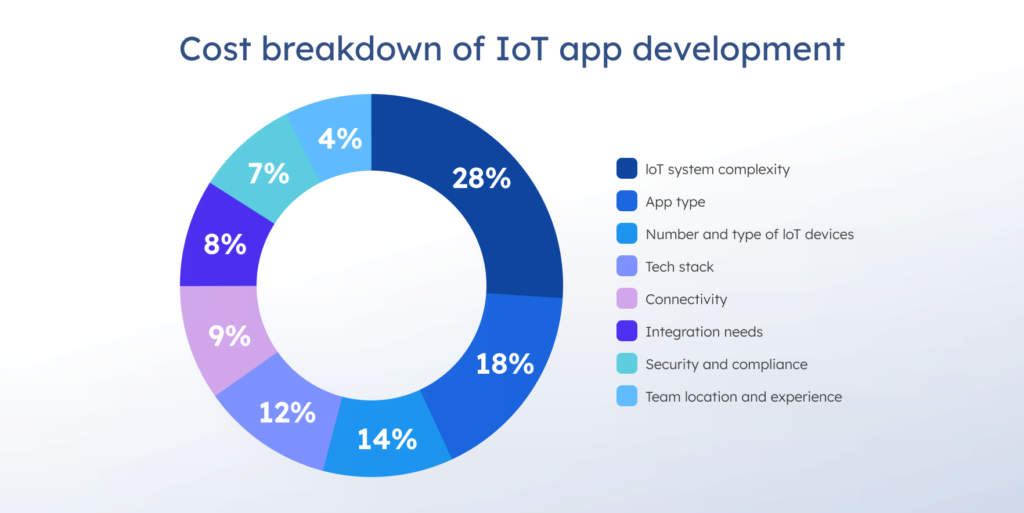
IoT system complexity
Cost fluctuations associated with IoT app development are mainly driven by their complexity. The more features you want to add, the more time developers will need to write code and test the system functionality. In general, IoT applications can be divided into the following three groups:
A basic IoT application cost around $30,000 to $50,000 with a limited number of connected devices and sensors, basic UI, no automation and limited functionalities. It typically includes:
- User registration and login
- Profile management
- Simple dashboard
- Push notifications
Examples: light detection system, smart room controls
Timeline: 2–3 months
An average IoT application goes up from $50,000 to $80,000 and usually includes multiple device support and a cloud connection to sync data in real time. The core features are:
- Advanced analytics dashboard
- Real-time chat
- Role-based access
- Integration with third-party services
- Remote control and automation settings
Examples: occupancy monitoring and energy management systems
Timeline: 4–5 months
A complex IoT application falls within $80,000–$200,000+ and consists of multiple devices connecting across different locations and networks. They are suitable for large-scale use, for example in manufacturing, or healthcare systems, include advanced technologies like AI and multiple advanced features, such as:
- Scalable device management
- Custom alerts and analytics dashboards
- API integrations with ERP or enterprise systems
- AI-based recommendations
- Strict security and compliance with HIPAA, GDPR, or ISO
Examples: industrial equipment monitoring and real-time grid coordination systems
Timeline: 6–8+ months
App type
The type of IoT application you choose to develop will determine its cost. For example, building a cross-platform mobile app is much cheaper than building two native solutions, helping reduce costs and shorten launch time. In turn, native apps provide maximum performance, direct hardware access, and stronger security, while cross-platform solutions offer a single codebase for multiple platforms that speed up development time, costs and time-to-market.
Each platform type comes with different specifications. So the best suitable choice will depend on your target audience (their devices and OS), project and product requirements, budget, scalability, and ongoing support.
Number and type of IoT devices
IoT devices are specialized hardware like sensors, actuators, and appliances that connect to wireless networks to collect, transmit, and process data. Simple ones like smart home devices and wearables systems, usually rely on common communication protocols, like Wi-Fi or Bluetooth. They require minimal processing power, low connectivity needs, and are generally cheaper to integrate.
Complex devices, like industrial equipment and transportation systems use more specialized communication protocols like Zigbee or LoRaWan and require high processing power, strong security, and reliable connectivity. They are more difficult to integrate and take longer to build.
The cost of developing IoT applications is influenced by both scale (number of devices) and their complexity (device type). Decide carefully when it comes to selecting and pay close attention to not only budget but also app requirements.
Tech stack
As we already said, IoT architecture consists of some layers, each with components that require a specific set of tools. The chosen tech stack directly influences how fast you can build your app, how complex the system will be, and how much you spend later on maintenance and scaling. A simple tech stack may have lower upfront costs but greater vendor lock-in and limitations in scalability. A well-chosen stack may have the opposite.The common tech stack for IoT app development looks like:
- Frontend: Flutter, Swift (iOS), and Kotlin (Android)
- Backend: Python, Java, and Node.js, C, C++
- Hardware: Arduino, Raspberry Pi, ESP32, ARM Mbed OS
- Cloud platforms and infrastructure: AWS IoT Core, Microsoft Azure IoT Hub, TagoIO, Datacake, Blynk
- Connectivity protocols: MQTT, CoAP, HTTP(S), Zigbee
- Data analytics and integration tools: InfluxDB, Grafana, Power BI, Tableau
Connectivity
The connectivity module is a key cost driver, directly affecting both development and operational costs. Different connection methods require different levels of investment in infrastructure, hardware support, and data transfer costs. When it comes to selecting the connectivity technologies for your IoT app, you may consider:
Cellular IoT
- 2G/3G. A largely unused network in many regions.
- 4G. A standard cellular connectivity for various IoT devices.
- 5G. It is used for high-speed, low-latency IoT applications.
- NB-IoT. A low-power, wide-area cellular network that requires reduced bandwidth.
- LPWAN (Low Power Wide Area Network). Include cellular technologies such as LTE-M and NB-IoT and conserve device power by transmitting small amounts of data over long distances.
Non-Cellular LPWAN
- LoRaWAN (Long Range Wide Area Network). Suitable for low-power, long-range connectivity for small data transmissions from large volumes of devices and sensors.
- SigFox. Connects devices and sensors at low cost in the most energy-efficient way.
Short-range technologies
- Wi-Fi. Provides high throughput for IoT devices but has a limited range and consumes significant power.
- Bluetooth Low Energy (BLE). Offers short-range, wireless, low-power communication between devices with low energy consumption.
- ZigBee. Consumes low power and offers seamless communication between multiple devices over short distances.
Other connectivity technologies:
- Satellite. Enables global communication by transmitting data between ground stations and satellites, providing extensive coverage for IoT applications.
- RFID (Radio Frequency Identification). A wireless technology that uses electromagnetic fields to automatically recognize and track tags stuck to objects.
- NFC (Near Field Communication). A short-range wireless technology that enables secure, contactless communication between devices.
The right connection type not only improves your app’s functionality but also helps you control costs and speed up deployment. Cellular technologies can increase costs due to network usage fees and complex infrastructure requirements. LPWAN solutions can reduce costs by enabling low-power, long-distance data transmission. Short-range technologies such as Wi-Fi or BLE can reduce communication costs but may increase infrastructure spending if additional gateways are required.
Integration needs
Third-party integration is an essential component of IoT development. It allows your app to communicate with other systems, services, and platforms, use external data, and add new features without having to build them from scratch. You will need to build or integrate APIs to connect the required services to your app. Each integration requires time for development and testing, API compatibility checks, and ongoing maintenance, all of which add up to the final cost.
Some of the main integrations that your IoT app may have:
- Cloud platforms. AWS, Microsoft Azure, and Google Cloud are used to ingest, process, store, and analyze vast amounts of data from IoT devices. Such platforms offer device management, real-time monitoring, and more, but come with ongoing costs for data storage and processing.
- Payment gateways. If your IoT app includes ecommerce features, you need to integrate a payment gateway like Stripe, PayPal, or Square. The price depends on fees and terms, which vary by payment provider, including whether the backend architecture is in-house or outsourced, the level of security and compliance, among others.
- Data analytics and AI. Analytics platforms, such as AWS IoT and Azure IoT, process and analyze a wide range of IoT data, often in real time. They include ML algorithms, data visualization tools, and predictive analytics models. The cost depends on the chosen platform, data volume, real-time processing, and storage requirements, etc.
- Voice assistants. Popular voice assistants like Amazon Alexa, Google Assistant, and Siri can enable you to remotely control your IoT devices via voice commands. But along with the benefits, it also requires additional coding, API management, and rigorous testing for compatibility.
Security and compliance requirements
IoT systems collect and transmit sensitive data and integrate with multiple devices and networks, which increases the risk of security vulnerabilities. It is important to pay special attention to security and compliance throughout IoT development from the ground up. To protect that information and meet legal standards, developers must comply with the NIST Cybersecurity Framework (CSF), NIST SP 800-53, NIST IR 8259 & 8259A, the Industrial Internet Security Framework (IISF), and other regulations and frameworks.
Apart from that, they need to incorporate security mechanisms. They include end-to-end encryption, access controls, device identification, software and firmware updates, network segmentation, and more. The implementation of security controls must be complemented by comprehensive testing to ensure system effectiveness.
Quality assurance for a simple IoT device with a limited set of requirements can cost $8,000 to $10,000+, while testing a complex ecosystem of connected devices can cost $100,000+. Actual costs will depend on the complexity/scope of your app, as well as the number of elements you need to test against.
Team location and experience
The development team location is the single biggest factor in IoT app developer pricing. Rates vary significantly by region, and teams in different countries offer diverse hourly rates, such as:
| Region | Junior | Mid-level | Senior |
|---|---|---|---|
| United States | $50–$80 | $80–$130 | $130–$200 |
| Canada | $40–$65 | $65–$110 | $110–$170 |
| Western Europe | $40–$70 | $70–$120 | $110-$180 |
| Eastern Europe | $25–$45 | $45–$80 | $70–$120 |
| Latin America | $20–$40 | $40–$70 | $70–$100 |
| India | $15–$30 | $30–$50 | $50–$80 |
| Southeast Asia | $15–$25 | $25–$45 | $45–$70 |
Considering other IoT roles and salary in United States, take a look at:
| Role | Hourly rate |
| IoT architect | $60–$90 |
| IoT consultant | $50–$70 |
| Cloud/IoT integration engineer | $60–$110 |
| Embedded systems engineer | $70–$130 |
| IoT security specialist | $70–$150 |
| QA engineer | $40–$100 |
Regardless of location, a development team with extensive expertise in IoT can reduce project costs and avoid expensive reworks and pitfalls further. Still, companies can consider hiring freelancers that are at risk or find a reputable IT company that is more expensive but reliable.
IoT app development cost calculator
Estimate an IoT app development cost based on your requirements for team size, rates, and timeline with our calculator.
Challenges during IoT development
Budget planning for IoT app development is a complex and multi-layered process. It requires understanding not only the main app development stages and factors, but also the pitfalls that often lead to budget overruns. Fortunately, you can avoid them if you know beforehand.
Poor planning at the start
IoT budget overruns result from poor planning that fails to account for the complexity of the IoT ecosystem. Companies should conduct feasibility studies, risk assessments, and market research before designing any IoT app. The most common mistakes everyone makes when planning an IoT project:
- Skipping pilots and proof-of-concept testing to understand the real operation and costs of an IoT solution.
- Failing to plan every aspect of the IoT ecosystem (connectivity, security, integration, data management, support).
- Neglecting to allocate a reserve budget for unexpected expenses.
- Avoiding collaboration with experienced IoT specialists or partners that lead to piled up costly problems over time.
Integration issues
One of the primary factors behind IoT budget overruns is the complexity of integrating diverse devices. IoT environments are rarely limited to systems of a single type or manufacturer. They often consist of a collection of systems from different vendors, each using its own communication protocols. Ensuring proper integration requires middleware development, custom APIs, and regular maintenance. These initiatives are often not taken into the initial budgets.
The situation becomes worse when it comes to integrating legacy systems. Many companies already use existing infrastructure that needs to be linked to new IoT solutions. Combining old and new technologies often requires custom development and specialized knowledge, which can increase the project cost two- or threefold.
Data management problems
Organizations often underestimate the costs associated with storing, processing, and analyzing the data generated by IoT devices. The more data is piled up, the more effort and cost are required for effective data processing and management. What’s the upshot of all this?
First, cloud storage costs are rapidly rising, especially for long-term storage. Second, real-time data processing requires a powerful and stable infrastructure capable of handling large data flows without interruption. Companies can rely on edge computing to reduce latency and network congestion. But this adds new costs for equipment and maintenance. Finally, data itself is useless unless it can be extracted. To gain real insights, you need advanced analytics platforms. All these require additional tools, specialists, and costs which cannot be accurately predicted at the beginning.
Scalability pitfalls
Initially, a company launches a pilot project with 1–5 devices, everything works fine, and the costs seem acceptable. But this creates a false sense of “this will continue”. As the number of devices grows, new challenges arise.
First, an infrastructure that could handle light traffic can no longer handle the growing load and requires a major upgrade. The backend also needs to be rebuilt. Plus, essential features like load balancing, redundancy, and failover mechanisms are needed to support effective scaling – all of which cost money. Second, IoT device management becomes more complex and requires specialized enterprise-level IoT platforms that involve high costs, additional integrations, and ongoing maintenance expenses.
Connectivity concerns
At the start, companies think they can use existing Wi-Fi or a mobile network. But in practice, this approach proves to be insufficient. For stable operation, IoT systems often require separate networks, additional access points, or even specialized communication technologies.
The problem is exacerbated in remote or industrial areas. Here, organizations have to build their own networks or seek alternative solutions and ensure the stable operation of thousands of devices simultaneously. As a result, connection costs become constant and significant, though they are typically underestimated during planning.
Maintenance and upgrades
Implementing IoT solutions is rarely limited to one-time costs for purchasing and installing equipment. In reality, devices degrade over time, their components lose efficiency, and their software becomes outdated and requires regular updates. Companies that focus solely on initial implementation costs overlook the long-term financial burden of maintenance.
This includes not only physical repairs and component replacements, but also regular firmware updates, bug fixes, cybersecurity, and maintaining compatibility with other systems. The need for remote diagnostics adds another layer of complexity and extra costs. Without built-in monitoring tools, companies often learn about problems only after a failure occurs and the device stops functioning. This leads to downtime, data loss, or reduced service quality, all of which directly impact costs.
How to reduce IoT app development costs?
Controlling IoT solution development costs begins with careful planning and its precise execution. Here are some smart strategies for reducing development costs while maintaining the quality of an IoT application:
- Start with an MVP. It helps you validate the concept of your app quickly with limited upfront investment and avoid unnecessary spending on features that may not add value.
- Manage data storage efficiently. Storage only useful and relevant data, regularly removing obsolete information. Also, you need to optimize data storage to reduce long-term costs and improve system performance.
- Use open-source frameworks and tools. Such tools as Arduino, Eclipse IoT, and Node-RED reduce coding time, lower licensing costs, and accelerate development without heavy financial investment.
- Select the right tech stack. It helps you minimize integration issues, avoid overengineering, and reduce long-term maintenance costs.
- Use existing hardware solutions. Pick carefully from off-the-shelf devices that meet requirements without unnecessary performance overhead, rather than building custom hardware from scratch. It lowers production costs, and shortens development cycles.
- Partner with an experienced IT provider who offers transparent prices. Choose a provider with extensive IoT development experience to reduce rework and bug fixes down the road. Make sure the company offers transparent prices to anticipate potential budget overruns.
- Implement a scalable cloud infrastructure. Solutions like AWS IoT or Azure IoT Hub help manage costs by paying only for the resources you use. This provides flexibility and reduces initial infrastructure investment.
- Implement testing early on. It can reduce bug-fixing costs and shorten the project timeline. The later you implement quality assurance for your product, the higher the risk of encountering bugs and unexpected issues as development progresses.
- Plan maintenance and updates wisely. Instead of frequent updates, you can focus on planned releases to fix critical issues first and delay non-essential updates. It ensures better use of development resources and money over time.
Conclusion
Estimating the cost of developing an IoT application is a daunting task. The more features, devices, and integrations you include, the higher the expenses will be. At least, the final price of an IoT solution will depend on your business goals, IoT use case, and project requirements. If you want to create a full-fledged software with dozens of features and a stunning design, you should account for significant upfront investment, including both development and implementation costs, ongoing maintenance and scaling expenses. If your priorities are speed of development and a minimalist design with limited functionality, the development cost will be significantly lower.
Both types of development require a reliable, skilled IoT provider. SoftTeco offers a full range of IoT professional services helping businesses at every stage of product creation, testing, modernization, and maintenance. Our IoT portfolio covers solutions of different complexity delivered with accurate prices and transparent processes.
FAQ
How much does it cost to build an IoT application?
How long does it take to develop an IoT application?
Can outsourcing IoT development reduce costs?
What is the difference in cost between developing a hybrid and native IoT app?
Building a hybrid app usually costs between $50,000 and $100,000, making it a more budget-friendly option. Developers can create a single codebase that works across multiple platforms. That’s why these apps are cheaper and faster to build, but they may lag in performance and responsiveness.




Comments